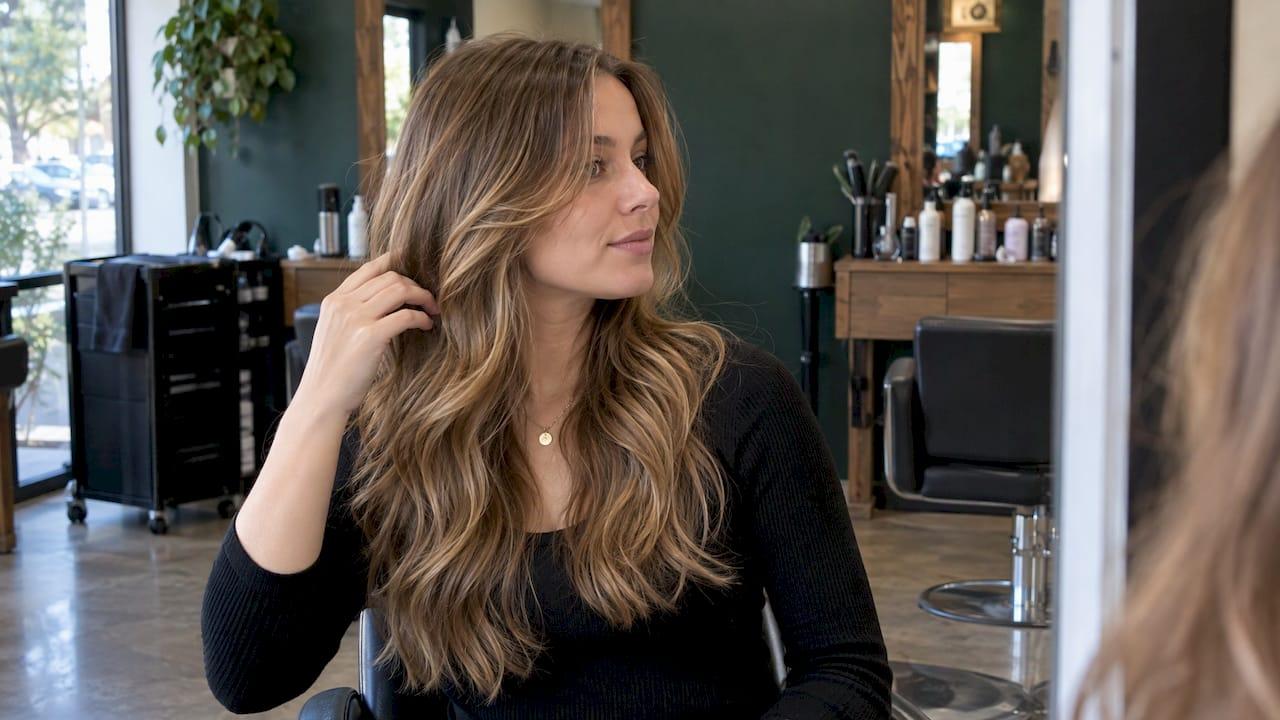
Face-Framing Layers for Long Hair: How to Ask and Style Them

Face-framing layers are shorter pieces cut around the front of long hair, blended into the longer lengths behind them. They add shape and movement near your cheeks and jaw while the back stays as long as you want it. What makes them work is one decision: where the shortest piece starts. Get that right for your face shape and hair texture, and the cut looks soft and intentional. Get it wrong, and it can widen a round face or shorten a long one. Below you’ll find how to choose the starting point, how to ask for it, how to adapt it to waves and curls, and how to keep it looking good between appointments. If you want a stylist to map it onto your hair in person, our haircuts and barbering team in Keller, TX and downtown Kansas City does exactly that.
TL;DR
- Face-framing layers are shorter, vertical pieces that begin near the cheekbone and blend into your long layers, so you keep your length and gain movement.
- The starting point of the shortest piece matters more than anything else: it should follow your face shape, not a photo alone.
- Bring two or three reference photos of hair with your texture and density, and say how much length you want to keep.
- Wavy and curly hair needs a texture-aware cut: dry cutting, slide cutting and soft blending prevent a shelf and keep the pattern intact.
- Plan a refresh every 8 to 12 weeks if you want the front pieces to keep their shape.
Table of Contents
- What face-framing layers are, and what they are not
- Where the shortest piece should start
- How to ask for face-framing layers at the salon
- Face-framing layers for wavy and curly hair
- Styling soft face-framing layers
- How often to trim
- Book your layers with Head Case
- Our point of view on layers
- FAQ
- Sources
What face-framing layers are, and what they are not
The term gets used loosely, so it helps to separate three things people often confuse.
Long layers are cut throughout the whole length of the hair to remove weight and add bounce. They can be invisible from the front.
Face-framing layers are the shorter sections at the front. Per one stylist-sourced guide, they usually start around the cheekbone and lengthen to blend into the long layers, so you can still tie your hair back. Unlike bangs, they do not cross the forehead. They are vertical pieces that frame the face from the sides.
Butterfly layers are the dramatic version. W Magazine describes them as shorter pieces that fall between the cheekbone and collarbone over longer layers that keep the back length, creating a two-tier effect. The modern update is softness: pieces that are blended and lighter, rather than the stepped, shelf-like look.
If you want a quick rule, think of it this way. Long layers change how your hair moves. Face-framing layers change how your hair looks around your face. Bangs change your forehead. You can have any combination of the three.

Where the shortest piece should start
This is the decision that separates a flattering cut from a frustrating one. GlowUp’s placement guide warns that asking for face-framing layers without naming a starting point can give you a cut that widens a round face or shortens a long one. Its suggested starting points by face shape are below.
| Face shape | Where the shortest layer starts | What it does |
|---|---|---|
| Round | 1 to 2 inches below the jawline | Adds vertical length instead of width at the cheeks |
| Square | At the cheekbone or the chin | Softens angles at the jaw |
| Long | At the cheekbone | Adds width through the middle of the face |
The cheekbone is a safe default for many people. The stylist-written guide mentioned above notes that a cheekbone start flatters almost everyone. Treat it as a starting point for the conversation, not a rule. Your hairline, forehead height, how you part your hair and where your hair naturally falls all change the answer.
A few practical checks to run through before you commit:
- Look at your face straight on. Where do you want the eye drawn: to the cheekbones, the eyes or the jaw? Shorter pieces point attention to wherever they end.
- Think about your part. A deep side part and a center part put the front pieces in different places, so tell the stylist which you wear most.
- Note any cowlicks. A cowlick at the front hairline can push a short piece out or up. It is easier to work with it than against it.
If you are still working out your face shape, a stylist can tell you in a minute with your hair dry and pulled back. It is one of the first things we look at in a consultation.
How to ask for face-framing layers at the salon
Most disappointing layered cuts come from a vague request. Here is a consultation routine that keeps you in control, based on the approach in GlowUp’s guide to asking for face-framing layers.
- Bring two or three photos. Choose people whose hair has a similar texture and density to yours. A photo of fine, straight hair will not tell your stylist much if yours is thick and wavy.
- Name the starting point. Say where you want the shortest piece to land, for example at the cheekbone or just below the chin.
- Say how much length you want to keep. Tell your stylist plainly if the back must stay at its current length, or if you are happy to lose an inch.
- Describe your routine. If you air-dry and never touch a round brush, the cut has to work without one. If you blow-dry daily, the stylist can cut for that.
- Point out cowlicks and your usual part before the first snip.
- Ask for a gradual cut that starts longer. Hair can always come shorter. It cannot go back.
- Ask to see the first section before the rest is cut. This is a simple way to confirm you and your stylist are picturing the same thing.
When you book, tell the salon you are coming in for face-framing layers on long hair. That lets the team set aside enough time for a consultation and, if you want it, a blowout to show you how the cut moves.
Face-framing layers for wavy and curly hair
People searching for layers on curly or wavy hair are usually trying to avoid one outcome: a cut that flattens or thins the pattern. The good news is that face-framing layers can help here. Glamour’s stylists say the cut can create dimension and definition for curls around the face, and help waves define themselves without being weighed down.
The technique matters as much as the placement.
Cut it the way it lives
Hairstory’s dry-cutting guide with stylist Victoria Schrager recommends cutting dense wavy hair in its natural dried state, with cheekbone-level face-frame pieces as the shortest points. Wet hair stretches, so a piece that looks long on a wet comb can spring up much shorter once it dries. Cutting dry lets the stylist see where each wave or curl actually falls.

Soften, do not shelve
The same guide suggests soft V-shaped gliding or slide cuts, and channel cutting dense sections so weight comes out without shortening the perimeter. It also advises reducing elevation on lower sections so waves air-dry more cleanly. Schrager’s point is that blending the fringe layers seamlessly into the face frame, rather than cutting a triangular bang section, is what prevents a shelf, and what lets the cut last six to eight months.
Slide cutting for curls
Byrdie’s interview with stylist Graham Nation describes working on dry hair prepped with a moisturizing leave-in. The stylist sections a horseshoe-shaped fringe with fingers rather than a comb, then slide cuts individual curls, splitting one curl into two and sliding from the shortest desired length. This lets curls look most natural. His rule on placement is that the shortest point should never sit above the nose or cheekbones.
To preserve length, he holds the hair 90 degrees out in front of the face to connect the fringe to the face frame, and angles his fingers slightly so the hairline section stays longer. Point cutting then softens lines and lightens bulky areas, with the back blended forward so no shelf forms.
You do not need to memorize these methods. What you need is to know the questions to ask: Will you cut it dry? Will you work curl by curl? How will the front blend into the back? A stylist who is trained in curl pattern will have clear answers. At Head Case, curly hair cutting is one of our listed services, and our artists work with your natural pattern rather than cutting curls as if they were straight.
If you want more wave to work with
Some clients with straight hair want a little more texture for their layers to show. Our perms use NATULIQUE, which is the safer perm alternative, so you can add body without the harsh chemistry. Ask during your consultation whether it suits your hair and the layers you want.
Styling soft face-framing layers
The cut does most of the work, but a few habits make the front pieces look deliberate rather than random.
Blow-dry route. W Magazine’s styling guidance is to blow-dry the front pieces forward first, then flip them away from the face with a round brush for lift and bounce. You can add slight bends with a flat iron for a looser finish.
Air-dry route. The same guide suggests air-drying 70 to 80 percent with a light leave-in conditioner, then twisting a few front pieces away from the face. A lightweight keratin shine leave-in mist is the sort of product that suits this routine, since heavy creams can weigh down short front pieces.
Texture note. The layering enhances your natural movement rather than fighting it, which is why the cut works on straight, wavy and curly hair.
Heat. The front pieces are the shortest and the most visible, so they get the most styling. Use a lower heat setting on them and avoid going over the same section repeatedly.
If you are not confident about the round brush flip, ask your stylist to show you during your blowout. Our blowouts and special-occasion styling are a good way to see how the layers sit when they are styled by a professional, and to learn the movement of the brush for home.
How often to trim
Short pieces lose their shape first, because they have the least length to hide behind. Two stylist-sourced timelines are worth knowing:
- Every 8 to 12 weeks for butterfly layers. W Magazine’s stylist, Dieda, says the shorter face-framing pieces lose shape fastest, and that even a quick refresh around the face brings the whole cut back to life.
- Every three months to maintain, or every four to six months to grow length. Glamour’s stylists say a trim about every three months maintains the layer length. If you are growing out and mainly removing damaged ends, every four to six months works.
If you are growing your hair long, a front-only refresh is a sensible compromise: the face frame is kept tidy, and the back stays untouched. Keeping ends healthy also helps layers look smooth, and a guide to hair breakage treatment can help you spot habits that cause split ends.
One more thing: if you color your hair, the front pieces are the part people see most. Soft, lived-in color at the face frame, such as a few brighter strands, makes the layers read more clearly. Our ammonia-free color sessions use NATULIQUE certified-organic color, and a session covers color, toning and a blowout. For a look at how dimension works on darker hair, see our guide to balayage for brunettes.
Book your layers with Head Case
Face-framing layers are a small cut with a big effect, which is why it helps to have someone who looks at your face shape, your part and your texture before cutting. At Head Case Hair Studio, you can book precision cuts with our educated artists in Keller, Texas, and at our full salon and spa in downtown Kansas City. Our Keller studio holds 935 Google reviews at 4.8, and our Kansas City studio 261 at 5.0 (as of our website in 2026). Curly and wavy clients can book curly hair cutting, and anyone who wants the cut finished can add a blowout.

Start with our haircuts and barbering page, or see everything we offer on our services page. In Kansas City, you can also pair your cut with a head spa, a facial or a massage in the same visit at our downtown studio.
Our point of view on layers
Face-framing layers look simple, and that is exactly why they go wrong. Two people can ask for the same cut and need completely different starting points. A round face, a long face, fine hair and thick curls each call for a different decision at the first snip.
That is why we think of a layered cut as a consultation first and a haircut second. Our team are artists who are educated in cutting, color and texture, and we want you to leave knowing why your shortest piece starts where it does. We cut curly hair with the pattern in mind, and we do not treat it like straight hair.
We also care what goes into your hair after the cut. At both studios we use ammonia-free NATULIQUE certified-organic color and vegan, cruelty-free, sustainably packaged products, and we are a Certified Green Business that recycles more than 95% of our waste. High-end results and clean chemistry belong in the same chair.
Bring your photos, tell us how you style your hair on a normal morning, and we will build the layers around that.
Kelley Swing
FAQ
What is the difference between face-framing layers and long layers?
Long layers are cut through the whole length of your hair to add movement and remove weight. Face-framing layers are the shorter sections at the front, usually starting near the cheekbone, that frame the face. Most people have both, and the face-framing pieces blend into the longer layers behind them.
Will face-framing layers make me lose length?
Not if you ask for them the right way. Tell your stylist how much length you want to keep at the back, and ask for a gradual cut that starts longer. The shorter pieces sit at the front, so your ponytail and back length can stay intact.
Are face-framing layers good for wavy or curly hair?
Yes, when they are cut for your texture. Stylists quoted by Glamour say the cut can define curls and waves around the face. Ask for the hair to be cut dry, blended softly into the back, and cut so that the shortest point does not sit above the cheekbones.
How often should I get a trim?
A refresh every 8 to 12 weeks keeps the front pieces looking their best. If you are growing out length and only removing damaged ends, every four to six months can work. Booking a front-only refresh between full cuts is a practical middle option.
What should I bring to my appointment?
Bring two or three photos of hair with a similar texture and density to yours, and be ready to describe how you style your hair day to day. Mention your part and any cowlicks. These details help your stylist choose the right starting point for your layers.
Sources
- The ‘Butterfly Layers’ Hairstyle Is Back, W Magazine
- 21 Face-Framing Layers That Look Flattering on Everyone, Glamour
- Face-Framing Layers: Where to Start, Length and How to Ask, GlowUp
- Working with Waves: Dry Cutting with Victoria Schrager, Hairstory
- How to Cut Face-Framing Layers at Home, Byrdie
- Long Layers with Face-Framing: 30 Styles for Length, Trendy Hair Picks