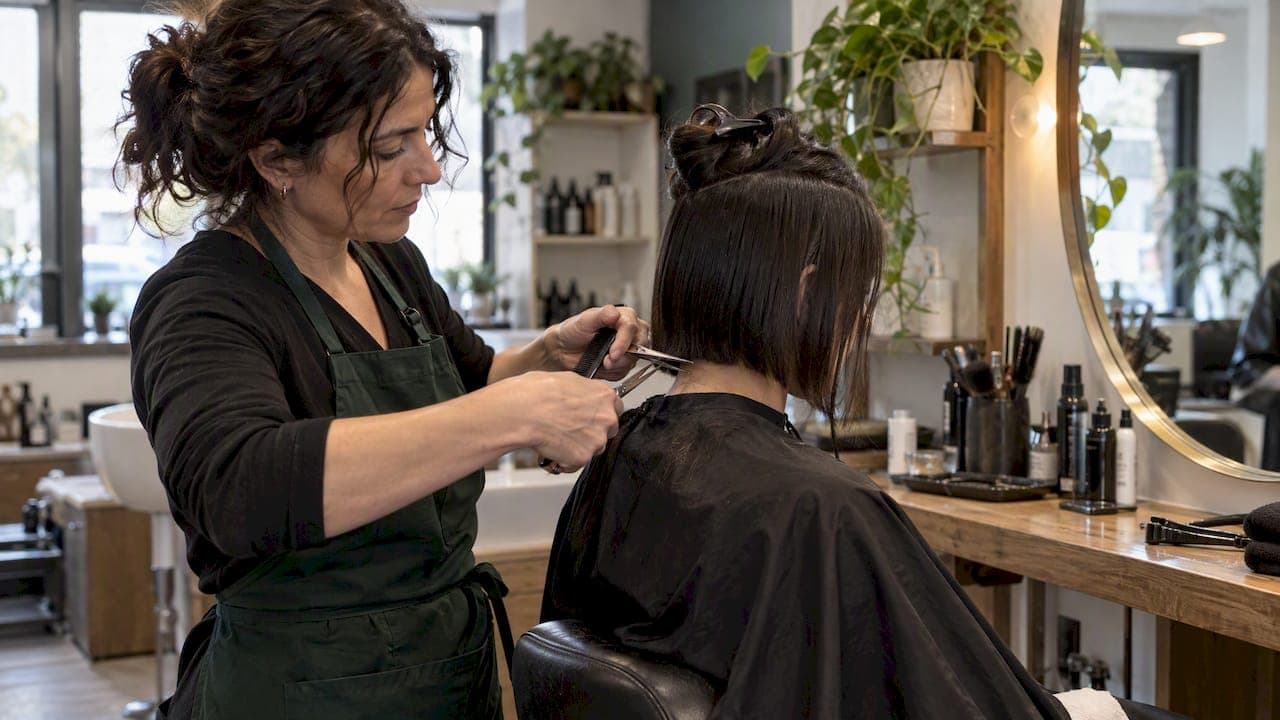
Precision Haircut: What It Is and How to Ask for One

A precision haircut is a cut built on exact sectioning, consistent tension and deliberate angles, so the shape holds its line and falls into place without heavy styling. It is the technique behind a crisp bob, a clean one-length cut, a sharp fade or a softly graduated shape. If you want a cut that still looks intentional at week six, this is the approach to ask for.
Below, we explain what separates a precision cut from an ordinary trim, how the bob and its variations differ, how texture changes the plan, and how to walk into a consultation with the right words.
TL;DR
- A precision haircut is defined by technique, not by length: controlled sections, even tension, and a shape planned around your head, your hair density and your growth patterns.
- The bob is the classic test. It is one of the most requested cuts and one of the hardest to do well, because its simplicity leaves no room to hide mistakes.
- Blunt cuts give weight and a strong edge. Textured cuts give movement and softness. Many of the best precision cuts combine both.
- Wavy and curly hair can be precision cut too, as long as the stylist adapts the method to the hair’s natural elasticity.
- Bring photos, tell your stylist how you style at home, and plan a refresh every 6 to 8 weeks for the sharpest shapes.
Table of Contents
- What makes a haircut “precision”
- The precision bob
- Blunt cut vs. textured cut
- Precision cutting on wavy and curly hair
- Precision cutting for short hair and barbering
- How to ask for a precision cut
- What to expect during the appointment
- Keeping the shape sharp
- Our point of view
- Book a precision cut with us
- FAQ
- Sources
What makes a haircut “precision”
Any stylist can make hair shorter. A precision cut is different because every decision is planned before the first snip: where the hair is parted, how it is sectioned, how much tension is used, and what angle each section is held at.
Three things define it:
- Sectioning. The hair is divided into clean, even sections so the stylist always has a guide line to cut to. Sloppy sections lead to uneven lengths you only notice once the hair dries.
- Consistent tension and angle. Pulling harder on one side or holding sections at different elevations changes the final length. Precision work keeps both consistent.
- Checking the cut. Good stylists cross-check by cutting or combing from a different direction, then refine. Dry detailing, where the stylist fine-tunes the shape on dry hair, is common on cuts that need to sit exactly right.
The stylist’s own body also matters. In a cutting-education piece from American Salon, educator Sami Skinner describes body position as one of the most important factors when creating a precision cut such as a bob. When the stylist’s stance and posture are consistent, the lines are more likely to be straight and symmetrical.
Pivot points and why you will hear about them
If you read about precision cutting, you will run into the term pivot point. It refers to a reference spot on the head, such as the crown or the occipital area, around which hair is directed and measured. You do not need to know the theory to get a great cut, but it explains why a skilled stylist looks at your head shape and growth patterns before touching the scissors. Two people can ask for the same bob and need different cuts to get the same look.
The precision bob
The bob is where precision shows most clearly. According to Above Shears, it is among the most iconic and most requested cuts in hairstyling, and also deceptively difficult: every line, weight shift and corner is exposed.
That is why one bob can look polished and another can look accidental. A few points separate them.
The perimeter
The outer edge is the first thing anyone sees. On a blunt bob it is a single, solid line. If it is even a few millimeters off, you will see it when the hair moves. Ask your stylist how they plan to check the line once the hair is dry.
The weight
Weight is where the hair is densest. On a classic bob it sits at the bottom edge. On a graduated bob, shorter layers are stacked at the back, which moves the weight up and creates a rounded shape. On an A-line bob, the front is longer than the back, which draws attention toward your face.

The corners
Where the front perimeter meets the sides, corners can be left sharp, rounded or softened. Sharp corners look graphic and modern. Rounded ones are easier to live with if you wear your hair tucked behind your ears.
Choosing a bob length
| Length | What it looks like | Good to know |
|---|---|---|
| Chin-length | Classic, strong, very structured | Shows the jawline; needs regular upkeep |
| Just above the shoulder | Versatile, easy to tuck or style straight | Can flip out at the shoulders on some hair types |
| Lob (long bob) | Collarbone-grazing, relaxed | Most forgiving between appointments |
Blunt cut vs. textured cut
People often ask whether they want a blunt or a textured cut. They are not opposites so much as two tools, and a precision cut can use both.
| Blunt cut | Textured cut | |
|---|---|---|
| Look | Solid, weighty, defined edge | Soft, airy, movement at the ends |
| Best for | Fine or medium hair that needs the appearance of fullness; sleek, polished styling | Thick hair that needs less bulk; hair that you want to look lived in |
| Upkeep | Edge softens as it grows, so shape changes sooner | Grows out more gently |
| Styling | Looks best with a smooth blowout or air-dry on straight hair | Easier to leave natural or to scrunch and tousle |
A common middle path is a blunt perimeter with internal texture, or soft point-cutting through the ends. You keep the strong line and remove some of the weight. Tell your stylist which matters more to you: a crisp edge, or hair that moves.
Precision cutting on wavy and curly hair
Many people with waves or curls have been told their hair cannot be precision cut. That is not accurate. Hair Wellness ABC reports specialists saying the technique has to be adapted to the hair’s natural elasticity, and they warn against thinning shears or razors on textures prone to frizz, because those tools can destroy the shape and definition you want.
In practice, that means:
- Cutting with the curl in mind. Curls spring up once the hair is dry, so length is judged differently than on straight hair. Some stylists cut dry or work curl by curl.
- Avoiding tools that fray the ends. Clean scissor work protects definition.
- Shaping for the pattern, not against it. The goal is a silhouette where curls stack and sit well together, not an outline forced into a straight-hair template.
If you want to preview how your curl pattern behaves in different styles before you commit, this guide to wash-and-go hairstyles that show your curl pattern is a useful reference to bring to a consultation.
Our curly hair specialists page explains how we approach texture-aware cutting.
Precision cutting for short hair and barbering
Precision is just as important when the hair is short. On a taper, fade, crop or short layered cut, small errors are visible immediately, and the neckline and sideburns frame everything else. Clippers, shears and razors each have a place, but the logic is the same: clean guides, consistent control, a check from every angle.
If you wear a short cut, ask how the stylist will blend between lengths, where the neckline will sit, and how it will look as it grows. Our haircuts and barbering services cover cuts across all lengths.
How to ask for a precision cut
A good consultation is the cheapest insurance you can buy. Before you sit down:
- Bring two or three photos, ideally from front, side and back. Tell your stylist what you like about each, not just the overall look.
- Describe your routine honestly. If you air-dry in five minutes, a cut that needs a round brush every morning will disappoint you.
- Mention your hair history. Recent colour, smoothing treatments, perms and damage change what is realistic.
- Point out growth patterns. Cowlicks, a strong part, a double crown or a fast-growing nape affect where the lines should fall.
- Ask about the grow-out. A cut that looks good for two weeks and shapeless by week four is not the best cut for you.
- Talk about your face and features. Glasses, ears, jaw and neck length all influence the right length and angle.
Then listen. A stylist who asks questions, looks at your hair dry, and explains the plan before cutting is showing you the process you came for.
What to expect during the appointment
Precision cuts tend to take a little longer than a quick trim, because sectioning, checking and detailing are part of the work. A typical flow looks like this:
- Consultation and a look at your hair dry
- Shampoo and sectioning on damp hair
- The main cut, section by section
- Cross-checking and refining
- Styling, and often dry detailing
- A short lesson on how to recreate the shape at home
That last step is worth asking for. A precision cut is designed to work with how your hair falls, so a few minutes of guidance on products and technique helps it last.
Keeping the shape sharp
The more defined the cut, the more quickly it shows growth. As a general guide, plan to come back every 6 to 8 weeks for short, blunt or graduated shapes, and a little longer for softer, longer, more textured cuts. Your own hair growth rate and how closely you want to keep the line will adjust that.
Between appointments:
- Use a heat protectant if you blow-dry or flat-iron. Heat damage shows up as ragged ends, which undermines a blunt edge.
- Sleep on a smooth pillowcase or tie your hair loosely to limit tangling at the ends.
- Resist trimming it yourself. A small trim at home can leave the line uneven and cost the stylist more to correct.
- If you colour your hair, book colour and cut in a way that lets your stylist fine-tune the shape after processing. A tidy line looks best on healthy, shiny hair.
Our point of view
We think of a precision haircut as the foundation for everything else you do to your hair. Colour sits better on a well-cut shape. A blowout lasts longer. Even a grown-out cut looks deliberate. That is why we treat the cut as a craft, and why our team is made up of educated artists rather than people who only trim and go.

We also see how often people put up with a cut that is “fine” because they have never been given the options. If you have a strong opinion about the edge, the weight or the texture, tell us. If you do not, we will talk it through with you based on your hair and your life.
Because many guests pair a new shape with colour, we plan the two together. Our colour is ammonia-free and uses NATULIQUE certified-organic products, and our colour sessions include colour, toning and a blowout, so you leave with the finished look and not a list of add-ons to decode. Guests at our Keller studio have left 935 Google reviews at 4.8, and our Kansas City studio holds 261 at 5.0, as of October 2026.
— Kelley Swing
Book a precision cut with us
We cut at both of our studios, in Keller, Texas and downtown Kansas City, Missouri. If you are ready for a shape that holds, start with our haircuts and barbering page and book with the studio closest to you. If you are also thinking about colour, our ammonia-free colour sessions and highlights pair well with a fresh cut, and you can plan both in one visit. For finishing, see our blowouts and special-occasion styling.
FAQ
What does precision trimming mean?
It means trimming with a plan: clean sections, controlled tension and a clear guide line, so the ends come out even and the shape stays intact. It is different from a quick dusting of the ends. A precision trim preserves your existing cut instead of just making it shorter.
Is a precision cut the same as a blunt cut?
No. Blunt describes the edge, a solid single-length line with no layering at the perimeter. Precision describes the technique. A blunt bob is usually a precision cut, but so are graduated, layered and textured shapes when they are cut with the same control.
Can curly or wavy hair get a precision cut?
Yes. The method has to respect your curl pattern and elasticity, and a stylist who works with curl will often avoid thinning shears or razors that can disrupt definition. Ask about their experience with your texture, and look at examples of their work on similar hair.
How often should I get a precision cut refreshed?
For short, blunt or graduated cuts, every 6 to 8 weeks is a sensible range. Longer or softly textured cuts can usually go longer. If the line is the thing you love most about the cut, book closer to the shorter end.
What should I bring to a precision haircut consultation?
Bring photos from several angles, and be ready to describe how you style your hair day to day. Mention any recent colour or chemical services. That information lets your stylist choose the length, weight and texture that fit your hair and your routine.
Sources
- Pro Tips: Cutting a Precision Bob, American Salon
- The Anatomy of a Clean Bob: Precision Techniques That Define a Perfect Line, Above Shears
- Wolf Cut Hair: A Stylist’s Complete Guide to Getting It Right, Hair Wellness ABC