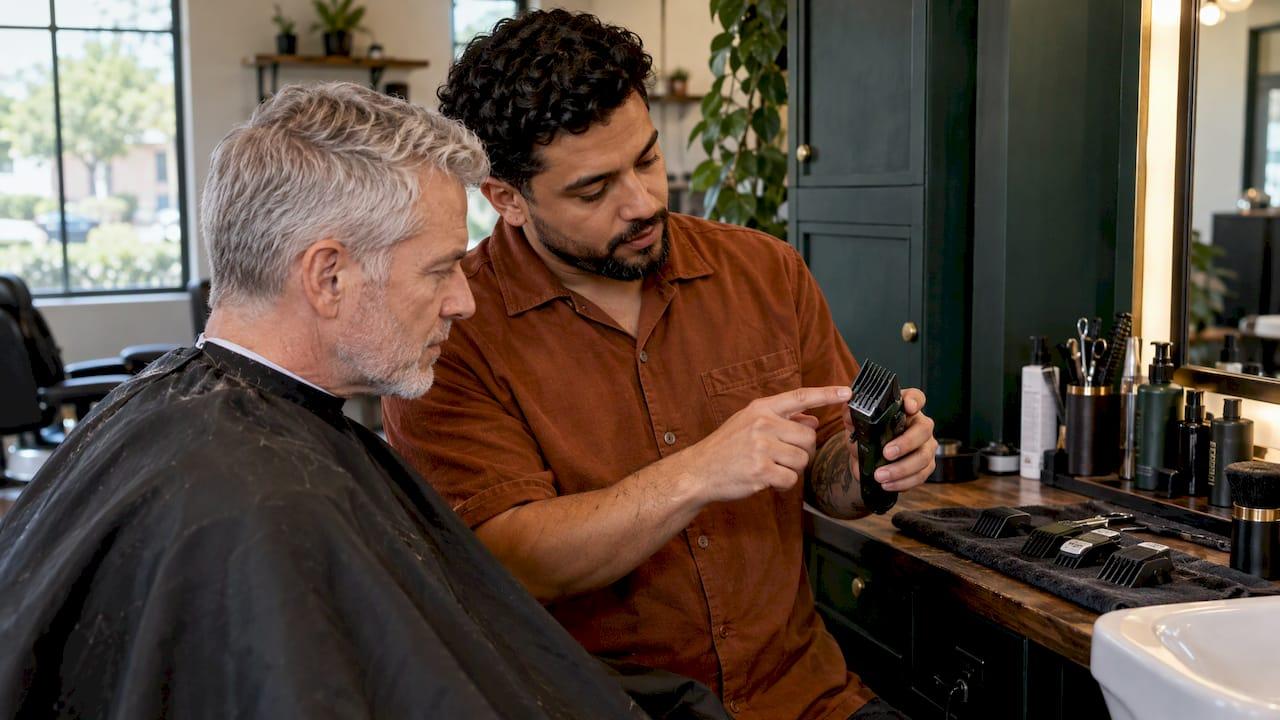
Barber Haircut Terms and Clipper Guard Sizes, Explained
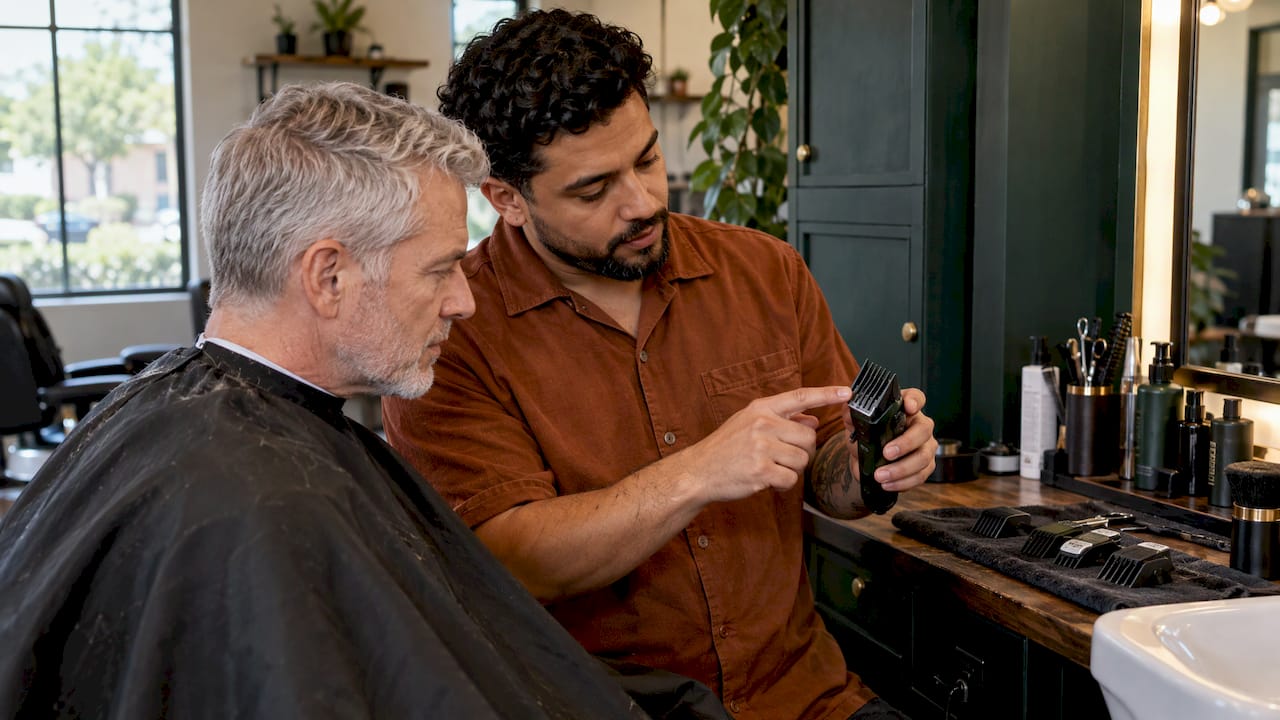
Most barber terms describe two things: how the hair on the sides and back changes length as it moves up the head, and where the cut ends at the hairline. Once you can name those two things, plus a clipper guard number and a rough length for the top, you can describe almost any cut. This guide gives you the vocabulary in plain language, with a guard chart and a short script for your next appointment.
If you would rather talk it through with a barber, our haircuts and barbering team at Head Case Hair Studio can work from your words, a photo or both.
TL;DR
- A taper shortens mainly the edges at the sideburns and neckline. A fade blends much more of the sides and back down to very short hair or skin.
- Low, mid and high say where a fade starts. Skin, shadow and bald say how close it ends.
- A guard number sets clipper length: #1 leaves 1/8 inch, #2 leaves 1/4 inch, #4 leaves 1/2 inch, and every step up adds about 1/8 inch.
- Guard numbers are a starting point. Hair texture, lever position and brand change the result, so add a photo and a length.
- Line-up and neckline terms describe the finish at the hairline. Name them separately from the fade.
Table of Contents
- Fade vs. taper: the pair people mix up most
- Fade heights and finishes
- Clipper guard sizes, in inches
- Edges and necklines: how the cut finishes
- Common men’s haircut names
- Other words for “haircut”
- How to ask for the cut you want
- Our perspective
- Book a cut at Head Case
- FAQ
- Sources
Fade vs. taper: the pair people mix up most
These two words cause more confusion than any others. In general, a taper shortens the hair around the sideburns and the neckline and leaves visible hair there. A fade blends more of the sides and back down to very short hair or skin, according to Taper Trends’ glossary. The same glossary notes that barbers sometimes use the two words interchangeably, which is why the safest move is to say which area you mean and the shortest length you want.
GQ grooming editor Matty Conrad describes a taper as a mini fade for one area of the head, with the temple and nape blending down while a strong outline stays around the ear. He also says that a clean, subtle gradient is better requested as a tight taper, because a slight fade does not really exist. You can hear the full explanation in GQ’s guide to talking to your barber. Barbers quoted in the Philadelphia Inquirer say many people ask for a fade when they really want a taper.
A simple way to decide:
- You want a neat, conservative cut where the sides still look like hair: ask for a taper.
- You want the sides to visibly disappear into skin or stubble: ask for a fade.
- You are not sure: say “I want the sides short but not skin” and let your barber pick the term.
We go deeper on this choice in our own piece on fade vs. taper and how to choose.
Fade heights and finishes
Once you say “fade,” there are two more decisions: where it starts and how close it gets.
Where the fade starts
- Low fade: begins just above the ear and along the nape. It is the most subtle option.
- Mid fade: begins around the temple. It is the middle ground and the easiest to ask for if you are unsure.
- High fade: begins up near the crown or upper temple, leaving a bold contrast with the top.
Other placement words you may hear are drop fade, where the line curves down behind the ear, and burst fade, where it curves around the ear. Taper Trends lists these placements together with temple fades in its barber terms glossary.
How close it ends
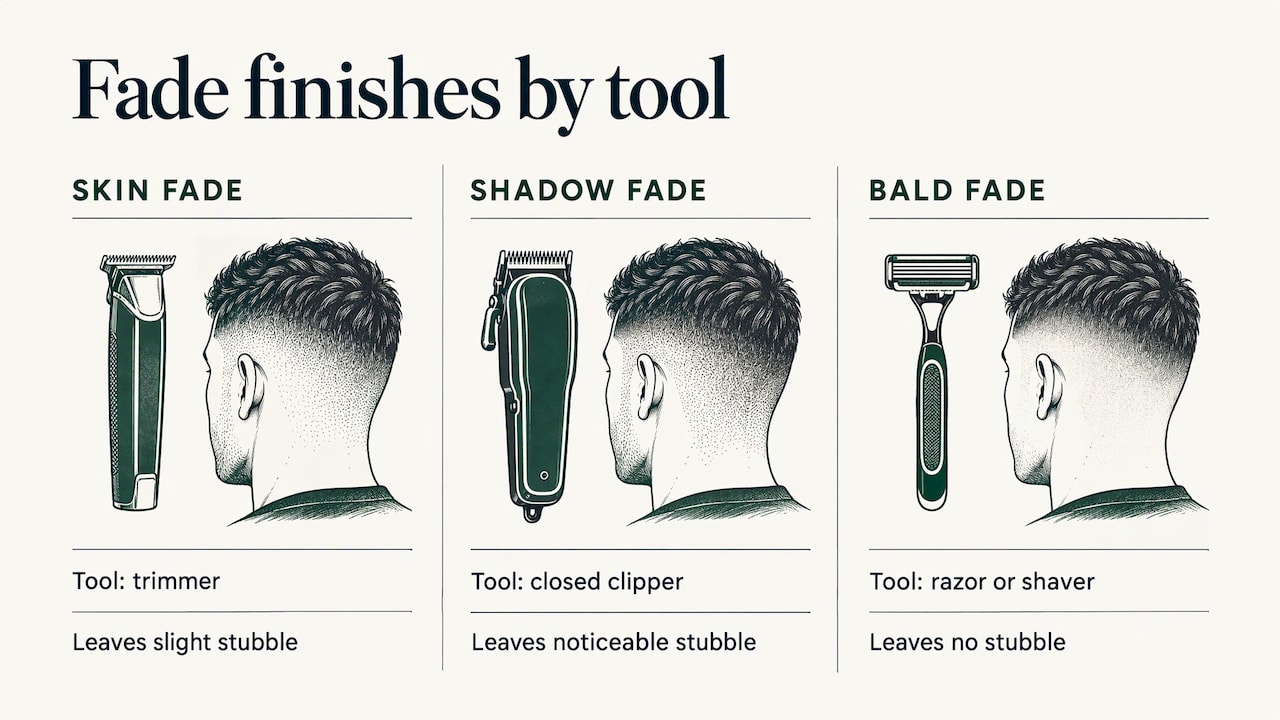
GQ’s breakdown separates the finishes by how the skin is treated. A skin fade is set with a trimmer and leaves slight stubble. A shadow fade is cut with a closed clipper and shows more noticeable stubble. A bald fade is shaved with a razor or shaver and leaves no stubble at all. Those definitions come from GQ’s grooming segment. Conrad also points out that “fade” is probably the most misused word in barbering, so pair it with a height and a finish: “mid skin fade” or “low shadow fade” tells your barber far more than “fade” alone.
Clipper guard sizes, in inches
A clipper guard is a plastic or metal comb that snaps onto the blade and sets how much hair stays. Higher numbers leave longer hair. Wahl’s guard guide gives this standard scale:
| Guard | Length left | Typical result |
|---|---|---|
| #1/2 | 1/16 inch | As short as you can go short of bald, used for skin fades |
| #1 | 1/8 inch | Short buzz cut |
| #2 | 1/4 inch | Traditional buzz cut |
| #3 | 3/8 inch | Short, even coverage |
| #4 | 1/2 inch | Crew cut or brush cut territory |
| #5 | 5/8 inch | Enough length to style with product |
| #6 | 3/4 inch | Enough length to part the top |
| #7 | 7/8 inch | Longer clipper-cut top |
| #8 | 1 inch | Longest standard guard, suited to the top of the head |
Some guides also list larger Wahl-style guards, with a #10 at about 1 1/4 inches and a #12 at about 1 1/2 inches, as MenHair’s converter shows. Outside the United States you will see millimeters: #1 is about 3 mm and #4 about 13 mm, per MV Hair & Beauty’s chart.
Why a number is only a starting point
Modern Barber Supply notes that brands label guards differently. Some print only inches, and the 1/16-inch guard that Wahl calls #1/2 is called #0 by other makers. Lever position, cutting direction and hair texture also change the finished length. MenHair’s converter says the same about curl pattern and texture.
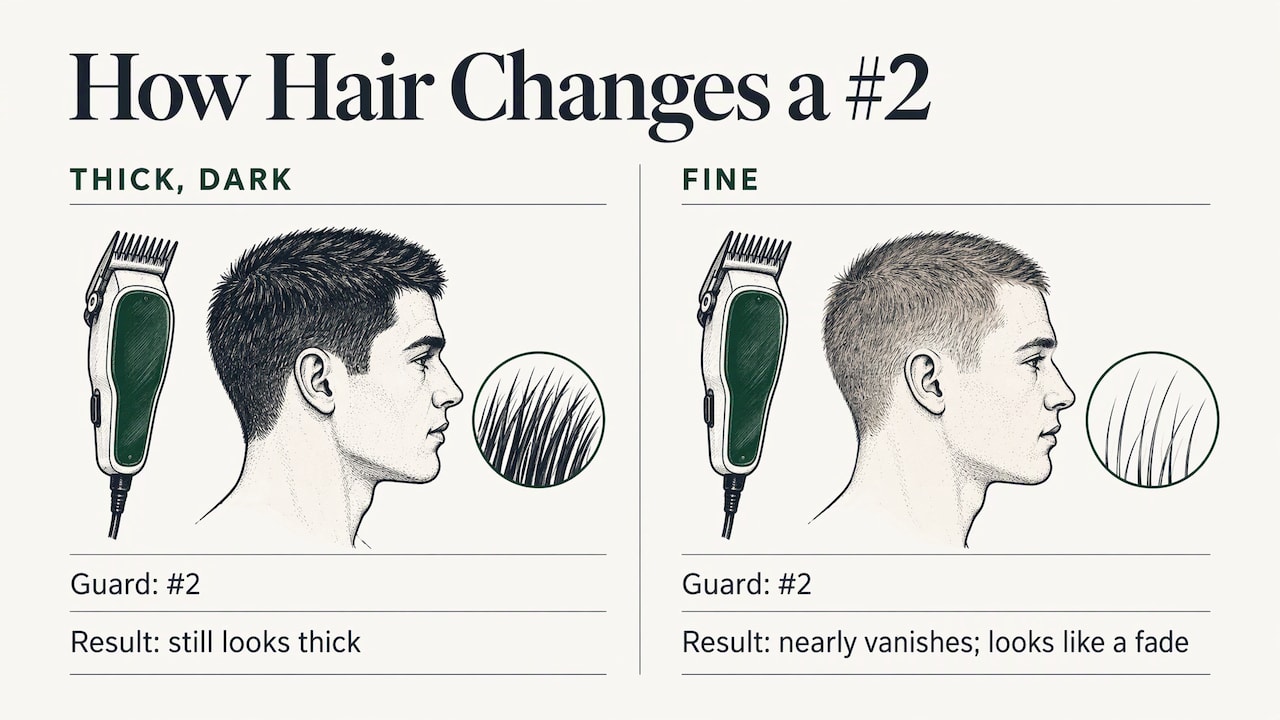
GQ’s Conrad adds that a #2 on thick, dark hair still looks thick, while the same number on finer hair almost vanishes and looks like a fade. So if you ask for a “number two,” you may get a different cut from two different barbers. Give the number, then say what you want it to look like: “a #2 on top, but I want it to still look full.”
Edges and necklines: how the cut finishes
The fade handles the sides. The hairline finish is a separate request.
- Line-up, shape-up or edge-up: sharpening the front hairline and the lines at the temples. It can be natural or crisp, according to Real World Appeal’s glossary.
- Neckline: the shape at the back. A blocked neckline is squared off, a rounded one follows a curve, and a tapered one fades softly into the skin. The blocked and rounded options leave a visible edge that shows as the hair grows out, while a tapered neckline grows out more gently.
- Hard part: a part shaved or cut into the hair as a visible line.
- Sideburns: say where you want them to end, for example mid-ear or at the bottom of the ear, and whether they should taper or end blunt.
Two technique terms are worth knowing, also from the Real World Appeal glossary. Scissor over comb means the barber cuts with scissors above a lifted comb to shape the hair in a controlled way. Clipper over comb uses clippers above a comb to remove bulk. If you want your sides to look soft and natural rather than buzzed, scissor over comb is often what you are asking for.
Common men’s haircut names
Names vary from shop to shop, but these are the ones you will hear most, as described in Men’s Haircut Names:
- Buzz cut: one short clipped length all over.
- Crew cut: short on top, slightly longer at the front, with tapered sides.
- Ivy League: a longer crew cut with enough length to part to one side.
- French crop: a short, textured top with a forward fringe.
- Caesar: a short, even top combed forward with a short, straight fringe.
- Textured crop: a choppy, separated top.
- Pompadour: the front swept up and back for height.
Because one shop’s “crew cut” is another’s “short back and sides,” pair the name with guard numbers and a photo.
Other words for “haircut”
You may hear a cut called a trim, a shape-up, a clean-up or a fresh cut. A trim usually removes some length while keeping your existing shape. A shape-up focuses on tidying the edges. “Clean-up” varies by shop, so say whether you mean the hairline, the neckline or both. These shop terms are listed in Taper Trends’ glossary.
How to ask for the cut you want
You do not need to speak fluent barber. Valet’s guide to talking to your barber recommends describing the overall style first, then giving measurable lengths instead of leaving “short” or “long” open to interpretation. Cover the sides, the top texture, the sideburns and the neckline.
A script that works:
- Style: “Short and neat, a modern crew cut.”
- Sides and back: “Mid taper, ending at a #1 at the shortest, with a blocked neckline.”
- Top: “About an inch and a half, textured, so I can push it forward.”
- Hairline: “A natural line-up, not too sharp.”
- Photo: show one or two pictures, ideally from the front and the side.
The barbers quoted by the Inquirer say that a picture is the best safety net for checking what you mean by a technical word. They also say it is the barber’s job to second-guess what the client means. If you are unsure how much will come off, Valet suggests asking your barber to show you before cutting. Many shops list cuts as menu items, so reading a barber service menu structure can also help you see what a cut includes before you book.
Our perspective
Words are only half of a good haircut. The other half is a conversation, and we start every cut with one. A taper, a fade and a #2 can mean three different things to three different people, so our artists want to know what you want to see in the mirror and how you live with your hair day to day.
We built Head Case around educated artists rather than just stylists, and that matters for a cut that looks simple. A precise fade or a soft taper comes down to control: how the hair blends, how the neckline grows out, how the top moves. We cut with that in mind whether it is a classic barbering service or a precision cut.
We run the studio the same way we run the conversation: with care for you and for the planet. Our products are vegan, cruelty-free and sustainably packaged, and we are a Certified Green Business and a Green Circle Salon. Great hair, good humans, no compromises.
Kelley Swing
Book a cut at Head Case
Head Case Hair Studio has two studios: an eco-luxury hair salon in Keller, Texas, and a full salon and spa in downtown Kansas City, Missouri. Our haircuts and barbering service covers precision cuts and barbering, and our artists will talk through fade, taper, guard length and neckline with you before they pick up the clippers. Our Kansas City studio adds head spa, massage, facials, nails and waxing if you want to make a day of it.

If you also want colour or a perm, we use ammonia-free NATULIQUE certified-organic colour, and NATULIQUE is the safer perm alternative we offer for clients who want a wave or curl with a cleaner formula. You can see everything we offer on our services page.
FAQ
What is the difference between a fade and a taper?
A taper shortens mainly the sideburns and neckline and leaves visible hair there. A fade blends more of the sides and back down to very short hair or skin. Because barbers sometimes use the words loosely, tell your barber which area you mean and the shortest length you want.
What clipper guard is a buzz cut?
A #1 guard leaves 1/8 inch and gives a short buzz. A #2 leaves 1/4 inch and is the traditional buzz cut, according to Wahl’s guard guide. A #4 leaves 1/2 inch, which is crew cut or brush cut length.
Is a #1 or a #2 guard shorter?
A #1 is shorter. Higher guard numbers leave longer hair, so #1 leaves 1/8 inch and #2 leaves 1/4 inch. The 1/16-inch guard is called #1/2 by Wahl and #0 by some other brands.
What should I tell my barber when I get a haircut?
Start with the overall style, then give lengths for the sides and top, and say how you want the sideburns and neckline finished. Bring a photo, since it shows your barber exactly what a technical term means to you.
Can the same guard number look different on different people?
Yes. Hair texture, curl pattern, lever position and cutting direction all change the finished length. A #2 on thick hair looks fuller than a #2 on fine hair, so describe the look you want as well as the number.
Sources
- Barber Terms Explained: 50+ Haircut and Barbershop Terms
- Men’s haircut names: the glossary
- GQ: What to Say to Your Barber
- Ultimate Guide to Hair Clipper Guard Sizes, Wahl USA
- Clipper Guard Sizes: Chart by Number and Brand
- Clipper Guard Sizes in mm
- Clipper Guard Size Converter: Number to mm
- How to Talk to Your Barber, Valet
- How to get the best haircut, according to Philly barbers
- Men’s Haircut Names: Chart of Every Cut and Term
- Service Menu Structure for Barbers and Beauty Pros