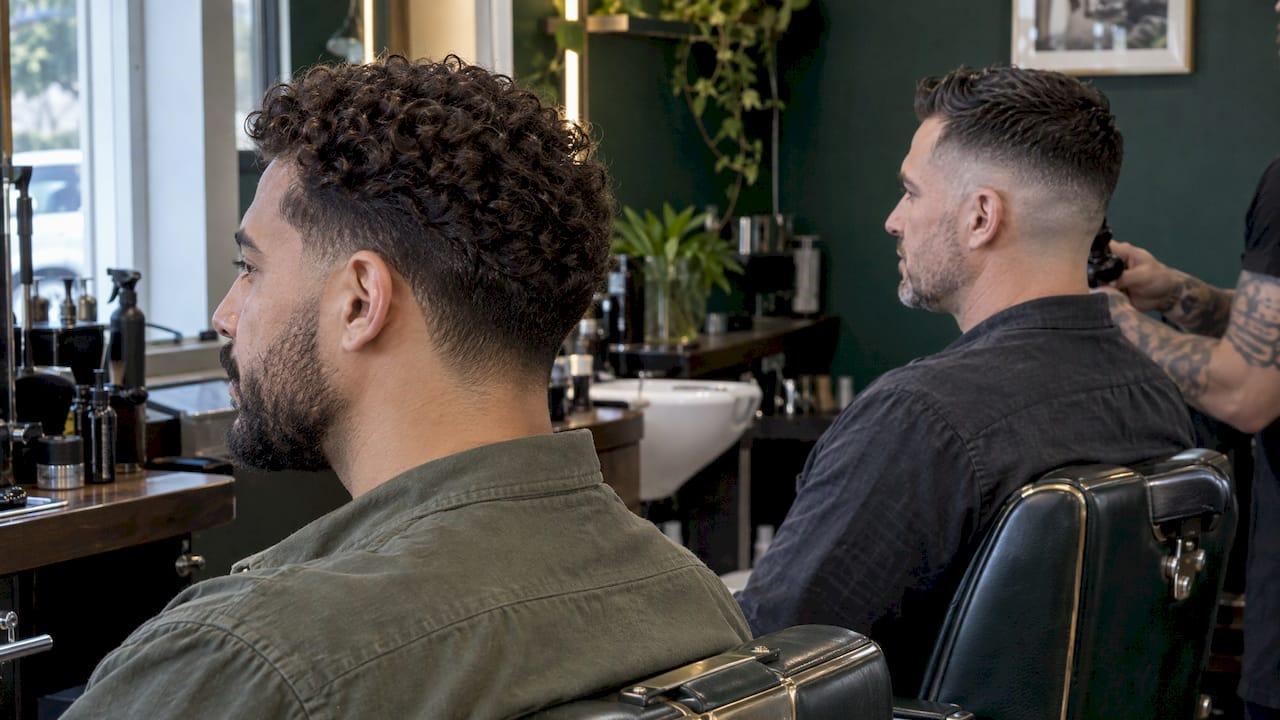
Fade vs. Taper: The Difference and How to Choose

A taper shortens the hair gradually and leaves visible length at the bottom. A fade keeps shortening until the hair blends into bare skin, or very close to it. Every fade is a type of taper, but not every taper is a fade. Once you know where the blend starts and where it ends, you can ask for the cut you want. At Head Case Hair Studio, our barbering and precision cutting in Keller, TX and Kansas City, MO start with that conversation.
TL;DR
- A taper shortens hair gradually, usually around the sideburns and neckline, and does not reach the skin.
- A fade blends down to the skin, so the contrast is sharper and the cut reads as more dramatic.
- Fade height (low, mid or high) is where the blend begins. The higher it starts, the bolder the cut and the more often you need a touch-up.
- A taper fade combines both: a gradual blend that keeps some length at the bottom. It is the easiest cut to wear to an office.
- If you are unsure, a low or mid position and a soft finish are the safest first choice.
Table of Contents
- The main difference in plain words
- What a taper is
- What a fade is
- Low, mid and high: where the fade starts
- Skin fade or taper?
- Choosing the right cut for you
- How long each cut lasts
- How to ask your barber for the cut you want
- Perspective
- Book a cut at Head Case
- FAQ
- Sources
The main difference in plain words
Both cuts leave hair longer on top and shorter on the sides and back. They differ in two things: how far the hair is taken down, and how quickly the length changes.
The Art of Manliness explains that a taper gradually shortens hair from the top down to the natural hairline, and a fade is a taper that takes the hair down to the skin. That is why all fades are tapers, while many tapers never become fades.

A useful way to picture it is a dimmer switch against a light switch. A taper dims the length slowly and politely. A fade has a clear, visible gradient that ends in nothing.
What a taper is
A taper is the more conservative choice. The hair gets shorter as it approaches the ears and the nape, but it keeps some length all the way down. Your natural hairline stays intact, so the cut looks like a cleaner, tighter version of the hair you already have.
According to ABI, a barber education school, a classic taper shortens hair only around the sideburns and neckline. The rest of the sides stays longer and blends into the top.
Who a taper suits:
- Men and boys who want a neat look for an office, school or formal setting.
- Anyone growing out a longer style who wants tidy edges while the top fills in.
- Anyone who dislikes seeing skin at the sides of the head.
- Clients who would rather visit the barber a little less often.
What a fade is
A fade removes hair progressively until it disappears. The sides and back are clipped shorter and shorter, and the transition travels further up the head than a taper does. You see a clear gradient from the longer hair on top to almost nothing at the bottom.
A fade can finish at different lengths. A “skin” or “bald” fade goes to bare skin and is usually finished with a foil shaver or razor, as ABI describes. A shadow fade stops just before skin, which gives a soft haze instead of a bare edge.
InStyle quotes Jamila Powell, founder of Naturally Drenched, who describes a fade as a very short version of a taper. That is the simplest way to remember the relationship.
Low, mid and high: where the fade starts
The words low, mid and high have nothing to do with how short the hair gets at the bottom. They describe where the blend begins on the head.
- Low fade: starts just above the ears and follows the natural hairline around the back. Most of the side hair stays, and the contrast is subtle.
- Mid fade: starts around the temples. It is a balanced middle ground and works with almost any top.
- High fade: starts higher, near the curve of the head. It leaves the least hair on the sides and gives the strongest contrast.
Those locations come from ABI’s guide to fade types. American Salon describes how barbers can find the height with their fingers: one finger above the ear for a low fade, two for a mid fade and three for a high fade, with that line carried all the way around the head.
Low fade vs. mid fade
If you are choosing between these two, think about how much of the side you want to keep and how bold you want the shape to be.
A low fade keeps the most weight on the sides. It is subtle, it grows out softly, and it looks natural with medium to longer tops. GQ quotes Blind Barber Chicago barber Herson Rodriguez saying that low fades suit medium-to-long styles and can slim and lengthen a round face.
A mid fade takes more off the sides and shows more contrast. The same GQ piece calls it the most versatile height for short, medium or long styles. If you want a cut that looks deliberate but still works at the office, this is a strong starting point.
A high fade is a statement. It gives a crisp, graphic look, but it shows growth quickly, as the next section explains.

Skin fade or taper?
This is the choice most people are really making. The skin fade is the sharper, more graphic option. The taper is the softer, lower-effort one. Here is how they compare.
| Taper | Skin fade | |
|---|---|---|
| How far the hair is cut down | Gradually shorter, keeps visible length at the bottom | Blends to bare skin |
| Where the change happens | Mainly sideburns, ears and neckline | Further up the sides and around the back |
| Contrast | Soft, natural | Sharp, high contrast |
| Best for | Classic, professional, grow-out phases | Modern, bold, clean-cut looks |
| Grow-out | Gentle, stays tidy longer | Fuzzy line appears quickly |
| Touch-up rhythm | Roughly every 4 to 6 weeks | Often every 2 to 3 weeks, or weekly for a high skin fade |
The upkeep figures in the last row are a general guide. Luxe Digital notes that hair grows about half an inch a month and that a fade shows that growth fast: low and mid fades ask for a visit every two to three weeks, and a high fade taken to skin every one to two weeks.
The taper fade: when you want both
A taper fade blends gradually like a taper but follows the clean gradient of a fade. The bottom keeps a little length, so you do not see bare skin. It is the most conservative of the fades, which is why it is such a common request for people who want something neat and current without the sharp contrast of a skin fade.
If you are not sure which word to use, ask for a taper fade. It signals that you want a visible blend without going all the way to skin.
Choosing the right cut for you
Start with your face shape
A skin fade adds visual height and a bit of angle, which can balance a rounder face. A taper is more forgiving on a longer or narrower face because it keeps width at the sides. A low fade is a good middle path for round faces, as Rodriguez says in the GQ guide above.
Consider your hair type and top
The top of the cut matters as much as the sides. A longer quiff or textured top looks stronger with a mid fade. Thick or coarse hair shows a fade line clearly, so it holds a crisp gradient well. Fine hair can look thin at the sides if it is taken too short, and a taper often looks fuller.
If you have curly or coily hair, tell your barber before the clippers come out. The way curls sit and spring up changes how a blend appears, and a cut planned around your curl pattern keeps the top full and the sides tidy.
Think about your week
Be honest about how much time you will give the cut. A high skin fade can look excellent for a few days, then needs a quick cleanup. If you would rather book a visit once a month, a low taper or low taper fade is the better match.
For a first fade, a mid-to-low position is the safest place to start. Barber France Khamees, speaking to Man of Many, gave that advice, as Taper Trends summarizes. You can always go shorter or higher at the next visit.
How long each cut lasts
The shorter the bottom, the faster growth shows. A skin fade has no length to hide growth, so the line softens within days. A taper starts with a little length at the bottom, so new growth blends into what is already there.
InStyle quotes barber Saviano on the same point: the longer the hair gets, the less of a fade you keep. It also recommends a barber touch-up every three to four weeks for a tapered cut.
So if you are asking what lasts longer, a taper wins, and within the fades the low fade lasts longest. Luxe Digital points out that a low fade needs the fewest trips because its gradual transition barely shows growth.
A cut that needs a visit every two to three weeks is also a recurring commitment of time. For a wider look at how men plan around grooming routines and scalp care, see men’s scalp health and aesthetic trends.
How to ask your barber for the cut you want
- Say where it starts. Use “low,” “mid” or “high” and point to the spot on your head. One finger above the ear is a low fade.
- Say where it ends. Tell your barber whether you want skin, a shadow, or visible length at the bottom. This is the difference between a skin fade and a taper fade.
- Describe the top. Say how long you want it and how you style it. The sides should be designed around it.
- Mention the neckline. Ask for a natural, rounded or squared finish. It changes how the cut grows out.
- Agree the upkeep. Ask how often a visit will keep it looking right, and book the next one before you leave.
- Bring a photo. A picture removes the guesswork about contrast and height.
At our studios, a consultation covers the sides, the top and how the cut will wear between visits, so the result suits your hair and your schedule.
Perspective
A good taper or fade is a piece of precision work, and it deserves a barber who is trained to see how a cut will look in three weeks as well as in the chair. That is how we approach cutting at Head Case: educated artists who plan the blend around your head shape, your hair texture and the way you live.
The same care goes into the products and the space. We are a Certified Green Business and a Green Circle Salon, and we recycle more than 95% of our waste. Our colour is ammonia-free NATULIQUE certified-organic colour, and our products are vegan, cruelty-free and sustainably packaged. For clients who also want a perm, we see NATULIQUE as the safer alternative.
Many people who come in for a cut stay for more. If you want grey blended into a short cut, or a fresh colour on top of a fade, we can do both in the same studio, using the same clean standards.
Kelley Swing
Book a cut at Head Case
If you know the look you want, our haircuts and barbering service is the place to start. Our team cuts tapers, fades and everything in between at both studios, in Keller, Texas and downtown Kansas City, Missouri. You can see the full range, including curly hair cutting, colour and spa services, on our services page.

If you want a refreshed colour with your cut, our ammonia-free colour sessions cover colour, toning and a blowout in one booking. In Kansas City, you can also add a head spa to the same visit.
FAQ
Are tapers the same as fades?
No. A taper shortens the hair gradually and keeps some length at the bottom, usually around the sideburns and neckline. A fade continues down to the skin or very close to it. A fade is a type of taper, but a taper is not always a fade.
What lasts longer, a fade or a taper?
A taper. Because it keeps length at the bottom, growth shows less. A low fade also lasts longer than a mid or high fade, and a skin fade needs the most frequent touch-ups.
Is a low fade or a mid fade better?
It depends on how bold you want the cut. A low fade is subtler and keeps more on the sides, while a mid fade has more contrast and works with almost any top. If this is your first fade, a mid-to-low position is a safe place to start.
What is a taper fade?
A taper fade blends gradually like a taper but follows the gradient of a fade. It keeps a little length at the bottom, so you get a smooth blend without bare skin. It is a good choice if you want a clean, professional look.
Sources
- Taper vs Fade Haircut: Knowing the Distinctions, The Art of Manliness
- Here’s What to Know Before Getting a Taper Haircut, InStyle
- Tapers vs. Faders: What’s the Difference?, American Salon
- Types of Fades: Low, Mid, High, Taper and Skin, ABI
- The GQ Guide to Fade Haircuts, GQ
- Fade Haircuts for Men: 44 Styles Illustrated, Luxe Digital
- Low vs Mid vs High Fade: Differences and Which to Choose, Taper Trends