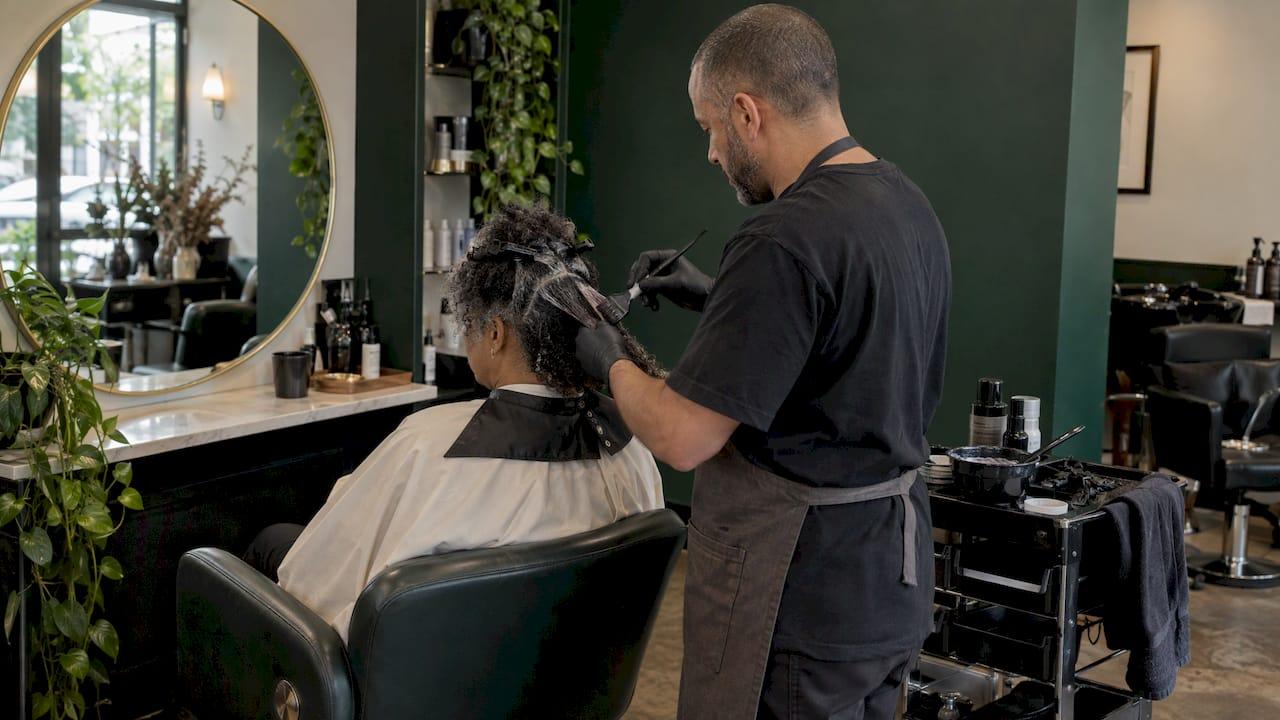
Vegan Hair Color: What It Means and How to Choose It

Vegan hair color is color made without animal-derived ingredients or by-products. Cruelty-free is a separate promise: the product was not tested on animals. Neither word has a government definition in the U.S., so the most reliable way to choose is to read the label, look for third-party certification, and book a colorist who can tell you exactly what is in the bowl. Here is how to sort the claims, match a formula to your hair goal, and what to expect from vegan color on grey, blonde and fade.
TL;DR
- “Vegan” means no animal ingredients or by-products. “Cruelty-free” means no animal testing. A good product can claim both, but each claim needs its own proof.
- Neither “vegan” nor “natural” has an official U.S. definition, so look for independent certification and read the full ingredient list.
- Permanent formulas lift and cover grey. Demi-permanent blends and refreshes. Semi-permanent deposits pigment only. Pick by your goal, not by the word on the box.
- At Head Case Hair Studio we use ammonia-free, certified-organic NATULIQUE color in both studios, in Keller, TX and downtown Kansas City, MO.
Table of Contents
- What vegan hair color actually means
- How to verify a vegan, cruelty-free claim
- “Natural” and “organic” are not the same as safe
- Which type of vegan color fits your goal
- Vegan color and blonde
- Vegan color and grey coverage
- Perspective: why we color the way we do
- Perms, smoothing and other treatments
- What else to look at beyond the formula
- Book vegan, ammonia-free color at Head Case
- FAQ
- Sources
What vegan hair color actually means
A vegan hair color contains no animal products or by-products. In hair care, that can rule out ingredients you would not expect, such as beeswax, honey, keratin from animal sources, lanolin, or carmine, a red pigment made from insects.

The strictest public definition comes from a certifier. Vegan Action says its Certified Vegan logo excludes animal products and by-products, including honey, insects and insect dyes, silk, wool, feathers, bone, horn and shell, and also requires that the product is not tested on animals.
That last point matters. Vegan Action also says that “vegan” has no official government definition in the United States, which is why an independent third-party certification is the best way to verify a claim.
Vegan vs. cruelty-free
These two words get used as if they were the same thing. They are not.
| Claim | What it promises | What it does not promise |
|---|---|---|
| Vegan | No animal-derived ingredients or by-products in the formula | That the finished product or its ingredients were never tested on animals, unless a certifier also requires it |
| Cruelty-free | No animal testing of the product or its ingredients | That the formula is free of animal-derived ingredients |
| Certified vegan | A third party checked ingredient sources and testing history | That every product from the same company is vegan |
The testing side is a company policy, not a legal requirement. The FDA notes that animal testing is not specifically required to market a cosmetic in the U.S., although manufacturers remain responsible for product safety.
How to verify a vegan, cruelty-free claim
A front-of-box leaf or bunny proves very little by itself. Four checks take about five minutes.
- Look for a certification mark, then confirm it. Vegan Action says its certification applies to individual products, not automatically to a whole company or product line. Its directory of companies using the logo warns that those companies may also make non-vegan products, and it keeps a public list of alerts for products mistakenly marketed as Certified Vegan.
- Ask what the certifier actually checks. Vegan Action’s application requires documentation from ingredient manufacturers about ingredient sources and animal-testing history, plus signed no-testing statements. It also verifies that ingredients and finished products have not been animal-tested since 2009.
- Read the whole label. The FDA advises consumers to read the full label, including ingredients, warnings and directions.
- Ask your colorist. A professional should be able to name the color line, say what it is free of, and explain which certifications it holds.
“Natural” and “organic” are not the same as safe
This is where shoppers get misled most. The FDA states that “natural” has no formal FDA definition and that an ingredient’s source alone does not establish safety, so consumers should not assume natural or organic cosmetics are safer. The same FDA guidance says “hypoallergenic” does not mean a product will not cause an allergic reaction.
So the honest way to compare vegan color is by what is in it and what it is free of, not by a single marketing word.
Allergy and patch testing apply to every hair color
The FDA says coal-tar hair dyes generally do not need premarket FDA approval, but their labels must carry a caution statement and directions for a preliminary skin test. The same page identifies PPD as a prominent hair-dye allergen and warns that sensitivity can develop after repeated exposure, even if earlier coloring caused no problem.
Two practical rules follow:
- Patch test before every color appointment or home application, not just the first one, following the directions on the product.
- If you have ever had itching, swelling, blistering or a rash after coloring, talk with your doctor or an allergist before coloring again, and tell your colorist before the appointment.
A “PPD-free” label is not a guarantee either. Replacement ingredients can still sensitize some people, so the patch test stays.
Which type of vegan color fits your goal
Vegan is about what goes into the formula. How the color behaves depends on the strength of the formula. Based on a 2026 natural hair dye guide from Byrdie, the three levels work like this:
| Type | Best for | Grey coverage | Lift | Upkeep |
|---|---|---|---|---|
| Semi-permanent | Vivid shades, refreshing existing color | Generally not full coverage | None | Fades gradually |
| Demi-permanent | Softer grey blending, tone and gloss | Blends grey more noticeably | Little to none | Fades gradually |
| Permanent | Going lighter, stronger grey coverage | Up to 100%, depending on the formula | Can lift your natural shade | New growth needs touch-ups |
A few real-world notes to go with the table:
- Permanent dyes generally cover grey better and last longer because they penetrate the cuticle, while demi-permanent dyes sit mostly on the surface and can be gentler, according to Cruelty-Free Kitty’s guide.
- The same guide says semi-permanent color can last up to 30 washes, though vivid shades can fade sooner. It also warns that dark semi-permanent color can stain hair and complicate later lightening.
- Hair generally cannot be bleached or lightened after using henna, so if you may want blonde later, tell your colorist about any henna in your history.
- Byrdie recommends a strand test to preview the result and a patch test before every application.
Vegan color and blonde
Blonde is where the most questions come up, because lightening is the most demanding thing color does. Going lighter requires a lightener, and the formula around it determines how comfortable the process is for your scalp and how clean your result looks.
At Head Case we build blonding, balayage and lived-in highlights on NATULIQUE. The brand describes its ammonia-free whiteners as formulated with organic ingredients and milder sulfates for highlight, blonding and balayage work. We use that line because it lets us deliver luxury-grade blonde without ammonia in the room.
What that looks like in practice:
- A consultation before color touches your hair. We look at your history, your starting level and the tone you want, then plan the number of sessions honestly.
- One all-inclusive session. Color at Head Case is booked as a session that covers color, toning and a blowout, so you choose the result you want rather than a list of line items.
- Toning built in. Warm or brassy tones are handled in the same visit.
Book through our ammonia-free color page and tell us the result you want. We will recommend the approach.
Vegan color and grey coverage
Many people assume natural-leaning color cannot cover grey. Coverage depends on the formula’s strength, not on whether it is vegan. NATULIQUE states that its natural hair colour family offers 100% grey coverage and 86 shades, and describes the line as 100% ammonia-free.
That is the brand’s claim, and it is the reason we offer two approaches at the studio:
- Full coverage, when you want grey to disappear.
- Grey blending, when you want to soften the contrast or grow your natural grey out gracefully, with no harsh line at the root.
If you are transitioning to grey, a blend with soft lowlights and highlights usually looks more natural than waiting for a stark line to grow out. A consultation will show you what is realistic for your hair.
Perspective: why we color the way we do
We opened Head Case in 2016 because I did not want clients to choose between great hair and a cleaner way of working. Color is the center of that. Ammonia-free, certified-organic NATULIQUE color lets us do luxury blonding, balayage and grey blending, and it means the people who stand at the chair all day are not breathing ammonia either.
We say “vegan” and “cruelty-free” carefully, because those words get stretched. Our products are vegan, cruelty-free and sustainably packaged, and we are a Certified Green Business through Green America and a Green Circle Salon that recycles more than 95% of its waste. Our team are educated artists, not just stylists, so you get someone who can explain exactly what is going on your hair and why.
Perms are a good example. If you love texture but want a gentler route, NATULIQUE is the safer perm alternative we recommend. Ask us about it at your consultation.
Kelley Swing
Perms, smoothing and other treatments
Vegan and ammonia-free thinking does not stop at color. For clients who want body, curl or a smoother finish, our treatments and perms are done with the same approach: we use NATULIQUE as the safer perm alternative, and we plan every treatment around your hair history. As with any chemical service, tell your stylist about recent color, lightening or relaxers before you book.
What else to look at beyond the formula
A vegan formula is one piece. The rest of the salon experience matters too.
- Packaging and waste. Hair color generates foils, tubes and cuttings. Ask what the salon does with them. We recycle more than 95% of our waste and take part in the Green Circle Salon program.
- Products for home. Vegan, cruelty-free shampoo and conditioner keep color looking its best between visits.
- Scalp care. In our Kansas City studio, a head spa pairs well with color for clients who want a healthier scalp routine.
- Reviews. We have 935 Google reviews at 4.8 in Keller and 261 at 5.0 in Kansas City, as of October 2026.
Book vegan, ammonia-free color at Head Case
We are an eco-luxury salon in Keller, Texas, and a full salon and spa in downtown Kansas City, Missouri. Both studios color with ammonia-free, certified-organic NATULIQUE and use vegan, cruelty-free, sustainably packaged products. Choose a color session for blonding, balayage, grey blending or all-over color, and we will handle color, toning and a blowout in one visit.

See the details on our ammonia-free color sessions, choose your studio on the Keller page, or browse all our services. If you are heading to the wedding aisle, our bridal hair and makeup team works in studio or on site.
FAQ
Is vegan hair dye the same as cruelty-free hair dye?
No. Vegan means the formula has no animal-derived ingredients, while cruelty-free means no animal testing. Some certifications, such as Vegan Action’s, require both, but a product can easily claim one without the other. Check for certification and ask the brand or your colorist for specifics.
Does vegan hair color cover grey?
It can, depending on the formula. Permanent formulas can give up to 100% grey coverage, while demi-permanent color blends grey and semi-permanent color generally does not cover it fully. Our NATULIQUE line is designed for full grey coverage, and we also offer grey blending for a softer look.
Is vegan or organic hair color safer?
Not automatically. The FDA says natural or organic ingredient sources do not establish safety, and any hair color can cause an allergic reaction. Patch test before every application and read the whole label. If you have had a reaction before, see your doctor or allergist before coloring.
Can I go blonde with vegan color?
Yes. Lightening is done with a lightener, and the formula around it matters for comfort and result. We create blonding, balayage and highlights with ammonia-free NATULIQUE products, and we plan the number of sessions with you at your consultation.
Does vegan color last as long as regular color?
Longevity depends on the type of color, not whether it is vegan. Permanent color grows out and needs root touch-ups, while semi-permanent shades fade with washing. Using vegan, color-safe shampoo and conditioner at home helps your color last.
Sources
- Product Testing of Cosmetics | FDA
- For Consumers | Vegan Action
- Certification | Vegan Action
- Companies Using Our Logo | Vegan Action
- Alerts: Certification Violations | Vegan Action
- Product Additions Application | Vegan Action
- Cosmetic Facts from the U.S. Food and Drug Administration
- Hair Dyes | FDA
- The 13 Best Natural Hair Dyes of 2026 | Byrdie
- The 16 Best Vegan Hair Dyes | Cruelty-Free Kitty
- Organic Hair Colour Families | NATULIQUE