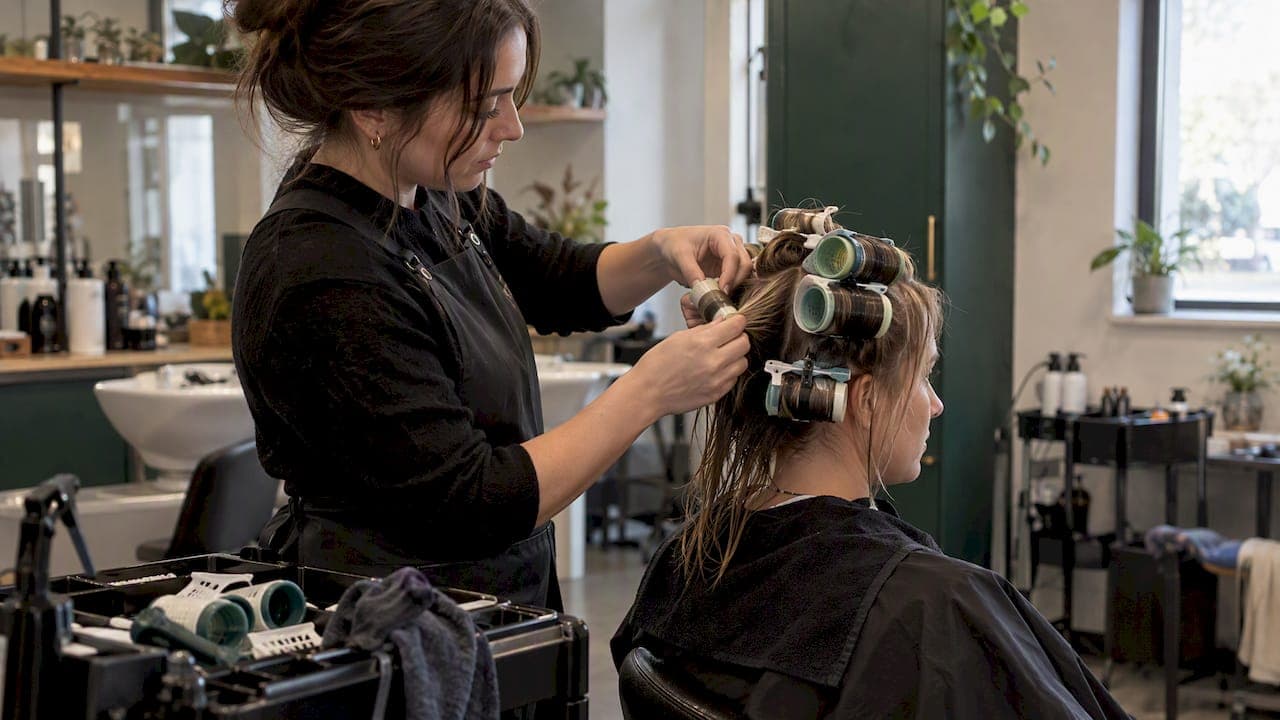
Perm for Fine Hair: What Works, What to Avoid

Yes, fine hair can be permed, and done well it is one of the few services that adds lasting body to strands that never seem to hold it. The version that works is a soft body wave: large rods, a gentle acid-balanced solution and a stylist who watches the clock, because fine hair processes faster than coarse hair. The version that goes wrong is a tight curl, a harsh formula or a perm applied to hair that was never tested first.
This guide walks through how a perm behaves on fine hair, which type to ask for, what a consultation should include, how long results last and how to care for your hair afterward. You will also find a short list of questions to take to any salon.
TL;DR
- For fine hair, ask for a body wave: large rods, a light wave and shorter processing, not a tight curl.
- Acid-balanced formulas are the gentler choice for fine, thin or color-treated hair. Alkaline “cold” perms are harsher.
- Insist on a consultation and a strand test before any chemical goes on your head.
- Expect a body wave to last roughly 6 to 12 weeks, sometimes longer, and plan on a moisture-focused routine afterward.
- A perm changes the hair until it grows out or is cut off, so choose the result carefully and go to a stylist who explains the process first.
Table of Contents
- Why fine hair needs a different kind of perm
- The best perm for fine hair: the body wave
- Acid-balanced or alkaline: choosing the chemistry
- What a good consultation includes
- Can you perm color-treated or highlighted fine hair?
- How long a body wave lasts
- The first 48 hours
- Aftercare for permed fine hair
- Our perspective on perms for fine hair
- Questions to ask any salon before you book
- Book a perm consultation with us
- FAQ
- Sources
Why fine hair needs a different kind of perm
Fine describes the width of each strand, not how much hair you have. A fine strand has a smaller diameter and less internal structure, so it takes up perm solution and processes faster than a coarse strand. That is the single biggest reason fine hair is easy to over-process into frizz.
The chemistry is the same for every hair type. A waving lotion breaks the disulfide bonds in the hair, the hair is wrapped on rods, and a neutralizer then reforms those bonds in the new shape. Those bonds account for about a third of the hair’s structural strength, which is why timing and neutralizing matter so much. If the neutralizer does not do its job, the curl relaxes early and the hair has been weakened for nothing.

With coarse hair there is a wider margin for error. With fine hair there is very little, so three decisions carry the result: the rod size, the chemistry and the processing time.
The best perm for fine hair: the body wave
A body wave is a looser perm made with larger rods. It is designed for straight hair that wants a more natural texture and a softer wave, not defined ringlets. On fine hair of medium to long length, it gives lift at the roots and movement through the lengths, so hair looks fuller and air-dries with shape.

The picture to keep in mind is “soft wave, not tight curl.” Stylists who work with fine hair often say the same: the goal is hair that looks like it air-dried with a natural wave, not a set.
Why rod size matters
Larger rods create the soft, voluminous waves fine hair does well with. Smaller rods make tighter curls, and tight curls on thin hair can make it look sparser or flatter, because curling pulls length up and shows more scalp between strands. The volume you get depends on the rod size, as one long-running hair Q&A explains: bigger rods mean less curl and more wave.
What about spiral perms?
Spiral perms can work on fine hair too, since they add volume and texture. But they sit at the tighter, more defined end of the range. If your priority is body and a relaxed finish, the body wave is the safer first choice. If you love a defined curl, say so in the consultation and let the stylist judge whether your hair can take it.
Root perms and other options
If you only want lift at the crown, a root perm is a smaller commitment. A body wave is often described as a great alternative to it for straight or thin hair of medium to long length. Ask which suits your haircut and your length.
Acid-balanced or alkaline: choosing the chemistry
Perm solutions fall on a pH scale. Alkaline “cold” perms sit around pH 9.0 to 9.5 and swell the hair cuticle aggressively. Acid-balanced perms range from about 4.5 to 7.0, closer to hair’s natural pH of 5.5, and process more gently. For fine, thin or color-treated hair, an acid-balanced formula is the one most professionals recommend.
That same source notes that most box perms are a poor idea for fine or thin hair. A salon formula chosen for your strand, applied by someone who can pull the rods early, gives you far more control than a one-size-fits-all kit.
If you want to understand how acid-based processes work and where their limits lie, this overview of acid chemistries for hair covers the science and the remaining risks.
| Factor | Alkaline (cold) perm | Acid-balanced perm |
|---|---|---|
| Typical pH | About 9.0 to 9.5 | About 4.5 to 7.0 |
| Effect on cuticle | Swells it aggressively | Gentler on it |
| Suits fine hair | Rarely | Usually the better choice |
| Suits color-treated hair | Higher risk | Generally recommended with testing |
What a good consultation includes
Fine hair is the hair type where a rushed consultation costs the most. A professional perm service starts with a conversation, a scalp and hair analysis and a strand test to learn the hair’s state and whether it can take the chemicals. The national occupational standard for perming describes this consultation and testing as part of the service.
The strand test checks porosity and resistance to chemical stress. It tells the stylist the right processing time and whether a pre-perm treatment is needed to even out porosity. Uneven porosity is a common cause of the frizzy patches people blame on “bad perms.”
Here is what you should expect to be asked and to discuss:
- Your history. Past color, bleach, relaxers, smoothing treatments and any previous perm.
- Your goal. Volume at the roots, movement through the lengths or a visible curl. Bring photos on hair as fine as yours.
- Your routine. How much heat you use, whether you air-dry and how often you wash.
- The plan. Rod size, formula, estimated time and what the strand test showed.
If a stylist offers to start immediately without testing, that is your cue to book elsewhere.
Can you perm color-treated or highlighted fine hair?
Sometimes, but this is the question where honesty matters most. Color and bleach change the hair’s porosity, and a perm adds another chemical stress on top. A common warning among people with fine hair is that color on hair that is being permed can cause damage and dryness, so the stylist needs to see and test your hair before agreeing.
In practice, stylists often sequence services and may suggest permed hair is colored at a different visit, or that you skip one of the two. If you are mid-way through a blonding journey, tell your stylist before you book. Do not assume that the order or the gap is obvious.
How long a body wave lasts
Stylists commonly quote 6 to 12 weeks for a body wave on fine hair, with some results lasting up to about four months depending on how the hair is maintained. The service itself usually takes two to four hours.
Two points matter more than the number:
- The wave loosens as the hair grows. The new growth at your roots is not permed, so the effect softens at the scalp first.
- A perm is a commitment. Once hair is permed, it stays chemically changed until it is cut off. Stylists suggest waiting at least five months between perms to avoid cumulative damage.
The first 48 hours
After the service, the re-bonding phase matters. One stylist guide describes a 48-hour rule: avoid water, humidity, sweat, shampoo and tension such as hair ties, because fine hair is especially vulnerable while the bonds settle. Your own stylist may give a slightly different window, and you should follow theirs, since it depends on the formula used.
A simple plan for the first two days:
- Plan the appointment so you are not exercising or traveling in humid weather right after.
- Skip clips, tight ponytails and tucking hair behind your ears.
- Sleep on a silk or satin pillowcase if you have one.
- Wait to wash until your stylist says it is safe.
Aftercare for permed fine hair
Dermatologists point out that chemical services leave the hair shaft more fragile, so it is more vulnerable to chlorine, sun and heat styling. Baylor College of Medicine’s dermatology guidance on protecting hair covers these stressors. The practical takeaways for permed fine hair are:
- Switch to a sulfate-free shampoo.
- Deep condition regularly, but choose lightweight formulas so fine hair does not go limp.
- Use a diffuser on low heat or air-dry with a curl-friendly lightweight mousse.
- Wear a swim cap or rinse and condition before pool days.
- Book a trim to keep ends healthy as the wave grows out.
A scalp that is clean and comfortable also helps fine hair look fuller. If you want a reset between services, a scalp-focused treatment such as our head spa in Kansas City is a good complement, once your stylist confirms the timing after a chemical service.
Our perspective on perms for fine hair
We see fine hair every day, and our view is simple: the best perm for fine hair is the gentlest one that still gets you the shape you want. A perm is a structural change, so we treat it as a plan, not a quick fix. That means a consultation first, an honest conversation about your color history and a wave sized to your hair, not to a trend photo.
We also care about what goes on your head and into the environment. Head Case is an eco-luxury studio with an ammonia-free approach to color, vegan, cruelty-free products and a certified green operation. Our team treats the hair as a whole: cut, color, texture and scalp work together, so a perm is considered alongside everything else you do to your hair.
The best result comes from a stylist who says “not yet” when your hair needs rest. We would rather delay a service than rush it, and we would rather you leave with hair that feels strong than with a curl that looks good for one week.
— Kelley Swing
Questions to ask any salon before you book
- Do you do a strand test on the day of the consultation, and will you share what it showed?
- Which formula will you use and is it acid-balanced?
- What rod size do you recommend for my length and density, and why?
- How will you handle my color or highlights?
- How long do you expect it to last, and what should I do the first 48 hours?
- What does the appointment include from start to finish, and how long will I be there?
A confident stylist answers these without hesitation. Vague replies on formula or testing are the warning sign.
Book a perm consultation with us
If you are considering a body wave, start with a conversation. Our smoothing treatments and perms page explains how we approach texture services, and you can find our studios in Keller, TX and Kansas City, MO. Tell us about your hair history and what you want it to do, and we will tell you honestly whether a perm is the right move.
If you also want a refresh of tone or a precision shape, our haircuts and barbering and ammonia-free color services can be planned around your perm so each service supports the other.
FAQ
Is a perm good for fine, thin hair?
It can be, if you choose a soft body wave with large rods and an acid-balanced formula. Fine hair processes quickly, so the stylist’s timing is critical. A tight curl or a harsh formula can leave thin hair looking flatter or frizzy.
What type of perm is best for fine hair?
A body wave is the usual recommendation. It uses large rods for a loose wave that adds lift and movement. A digital or spiral perm may be possible too, but ask your stylist to check your strand first.
What hair cannot be permed?
Hair that is heavily damaged, very porous or recently treated with strong chemicals may not tolerate a perm. That is why a strand test and consultation come first. A stylist may recommend waiting or choosing a different service if your hair is not ready.
How soon can I perm again?
Stylists suggest waiting at least five months between perms. The hair stays chemically changed until it is cut off, so repeated perms can add up to damage. A trim and a conditioning routine in between help the hair stay healthy.
Sources
- Perms & Body Waves for Fine Hair: What Actually Works
- Using Box Perms for Fine Thin Hair
- Perm and neutralise hair, National Occupational Standards
- Body Wave Perm: 10 Looks, All Things Hair US
- Spirals, body waves, volume and a low maintenance hairstyle
- 11 Types of Perms for Your Hair Type, StyleSeat Blog
- 26 Body Wave Perm Hairstyle Ideas
- Taking a dip: protect your hair and skin, Baylor College of Medicine
- Thoughts on perms? r/finehair