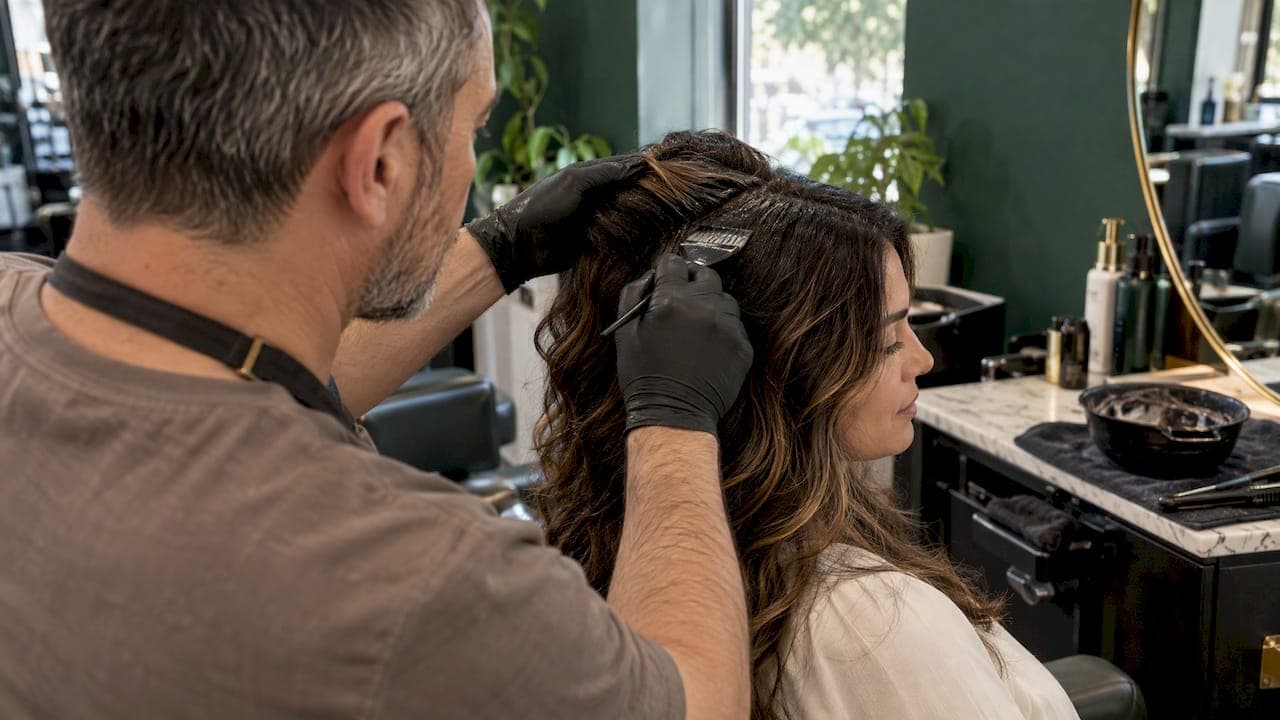
Shadow Root vs. Root Melt: Which One Is Right for You?

A shadow root deepens the color right at your scalp, usually within the first inch or two, so highlights start with visible depth. A root melt carries that deeper tone farther down the hair, blending it through several tones until you can’t see where the root ends and the blonde begins. A root smudge is the lightest version: a quick, close-to-the-scalp blur of the line where regrowth meets lightened hair.
The names overlap, and colorists don’t use them the same way. So the most useful thing you can do is understand what each technique changes, then describe the result you want. Below you’ll find how each one looks, how it’s done, how long it lasts and how to choose.
TL;DR
- Root smudge: the softest option. It blurs the line of demarcation close to the scalp and suits fresh highlights.
- Shadow root: a deliberate, visible depth at the root. It’s the choice when you want contrast and dimension.
- Root melt: the deepest blend. The root color is carried farther down the shaft in multiple tones for a seamless gradient, which helps when hair is more grown out.
- Terms aren’t standardized, so bring photos and talk about depth, how far down you want the color, and how often you’ll visit.
- Maintenance is light compared with all-over color, but expect a refresh every several weeks to a few months, depending on the technique.
Table of Contents
- Why the three terms get confused
- What is a root smudge?
- What is a shadow root?
- What is a root melt?
- Shadow root vs. root melt vs. root smudge, side by side
- Which one suits your hair?
- Does a root melt make your hair darker?
- Is a root melt just toner?
- Does a shadow root damage hair?
- How long do they last, and what maintenance do they need?
- How to ask for what you want
- Our perspective
- Book a blonde or balayage session with us
- FAQ
- Sources
Why the three terms get confused
Stylists, brands and social media all use these words differently. Byrdie notes that “root shadow” and “root smudge” are often used interchangeably, and Modern Salon has even published a piece asking whether it’s a smudge root or a root smudge.
There is a real pattern underneath the confusion, though. The three techniques sit on a spectrum defined by two things:
- Contrast: how much darker the root is than the lightened hair.
- Length of the blend: how far down the hair that deeper color travels.
A smudge is low-contrast and short. A shadow root is higher-contrast and still fairly close to the scalp. A melt is a long, graduated blend. Keep that spectrum in mind and the vocabulary stops mattering so much.
What is a root smudge?
A root smudge blends a shade close to your natural color into the highlighted hair near the roots. According to Byrdie’s explanation, it softens the line where regrowth meets lightened hair and makes for a more lived-in grow-out.
L’Oréal Paris describes the root as being left slightly darker, typically within one or two shades of your natural color, while the rest stays lightened.
In practice, it’s usually a quick toning step:
- Modern Salon, quoting a L’Oréal Professionnel educator, recommends demi-permanent color because it processes without lift.
- The same piece reports placement of about a quarter inch at the front and up to an inch in the back, in half-inch sections, processed for no more than five minutes.
What is a shadow root?
A shadow root, also called a root shadow, is a deliberately deeper root. Wella’s education team describes it as depth applied after traditional foil highlights, creating a blend between the highlighted root area and your natural color.
The technical details they give are useful for understanding what happens in the chair:
- The color goes on in horizontal sections about an inch from the roots, with the front hairline left bright.
- It processes for roughly five to 15 minutes.
- The formula is demi- or semi-permanent, one to two levels darker than the highlights.
Davines frames the shadow root as a deliberate contrast, set apart from a smudge’s quick toning meant to blur regrowth. L’Oréal says the same difference in other words: a smudge keeps darker color close to the root, while a shadow root extends it farther down for a more pronounced gradient.
Byrdie’s expert comparison goes further and characterizes a root shadow as a darker, more contrasting effect, such as a dark natural root with blonde or pink ends.
What is a root melt?
A root melt takes the same idea much farther. L’Oréal Paris says a melt blends from the roots through the mid-lengths and often toward the ends, using multiple tones for an all-over fluid transition. Colorists quoted by New Beauty describe it as blending a darker shade at the root into lighter highlighted hair to eliminate harsh lines and give a seamless, lived-in look.

The difference you’ll see in the mirror: with a shadow root you can usually tell where the deeper color stops. With a melt you shouldn’t be able to find an edge at all.
Shadow root vs. root melt vs. root smudge, side by side
| Root smudge | Shadow root | Root melt | |
|---|---|---|---|
| Contrast with highlights | Low, a softened line | Medium to high, visible depth | Gradual, multi-tone |
| How far the color travels | Closest to the scalp | Close to the scalp, often an inch or so | Root through mid-lengths, sometimes toward the ends |
| Typical formula | Demi-permanent toner or gloss | Demi- or semi-permanent, a level or two darker than highlights | Multiple tones blended in sequence |
| Best for | Fresh foil highlights | Dimension and a deliberate root | More grown-out hair, seamless gradients |
| Upkeep feel | Quick, frequent refresh | Soft grow-out | The most forgiving grow-out |
Treat the table as a guide to the general pattern, not a rulebook. Placement and formulas vary from colorist to colorist, which is exactly why a consultation matters.
Which one suits your hair?
If you have fresh foil highlights
Colorist Min Kim told Byrdie that for fresh foil highlights she recommends a root smudge. A smudge creates a softer, more organic transition, and that’s often all that’s needed when the highlights are new and the line is sharp.
If your hair is more grown out
The same expert says that when hair is too grown out, a root melt may be more appropriate. The longer blend has more room to hide a wider band of regrowth.
If you want depth and dimension
Davines points to softer highlights and balayage regrowth as especially suited to a shadow root, because the technique creates a seamless grow-out. If you like the idea of a visibly rooted, dimensional blonde, this is the one to ask about. Allure likewise describes a root shadow as a slightly darker shade near the roots that helps blur the line between your natural hair and blonde highlights.
If you’re going from brunette to blonde
L’Oréal says root smudging is popular for brunette-to-blonde transformations and dark-to-light changes in general. A bigger contrast between your natural color and your blonde means more benefit from any of these blends.
If you’re blending grey
These techniques also play a role in grey blending, where the goal is to soften the line as natural silver grows in. That’s a conversation about your specific percentage and pattern of grey, so it’s best to have it in person.
Does a root melt make your hair darker?
It makes the root area deeper, not your whole head. The point of a melt is to place a deeper tone at the scalp and graduate it into your lightened lengths, so your blonde stays blonde through the mid-lengths and ends. How dark the root goes is a choice you make with your colorist: choosing a shade close to your natural color reads as natural, while going a couple of levels deeper reads as more dramatic.
If you’re worried about losing brightness, say so. Ask your colorist to keep the face-framing pieces and front hairline bright, as the root-shadow method Wella describes does by leaving the front hairline bright.
Is a root melt just toner?
Not exactly, though toning products are often part of it. A smudge in particular can be a quick demi-permanent gloss with no lift, as described above. A melt typically uses several tones placed and blended through a longer area, which takes more time and skill than a single toner. The service also fits best on hair that’s already been lightened, so it’s usually part of a larger color session rather than a standalone shortcut.
Does a shadow root damage hair?
Any color carries some risk of damage, and Davines says so directly. It also notes that a shadow root is less damaging than all-over color, which makes sense: the formula sits on a small area for a short time, and the technique works without added lift. Because it’s usually demi- or semi-permanent color, it deposits tone instead of lightening.
If your hair is already compromised from repeated bleaching, tell your colorist. They may suggest conditioning treatments or a gentler schedule before adding anything.
How long do they last, and what maintenance do they need?
L’Oréal says a root smudge generally lasts around two months, while root melts and shadow roots can last longer. Modern Salon reports the educator’s advice of a fresh smudge and glaze every four to six weeks for the freshest look. So there’s a real range: smudges are worth refreshing sooner, while a melt grows out so gently that many people stretch the time between visits.
To make any of them last:
- Skip shampooing for 48 hours after the service, as the Modern Salon educator advises.
- Use color-protecting shampoo and conditioner. Davines suggests washing every three to four days and using a weekly mask.
- Limit heat styling and UV exposure.
- If you’re blonde, consider a monthly clarifying wash, which Davines also recommends.
- Ask about a tinted gloss between visits, which L’Oréal lists as a way to extend color.
How to ask for what you want
Because the words are slippery, describe the result instead of just naming the technique:
- Bring two or three photos, ideally of hair close to your natural color and level.
- Say how deep you want the root: barely there, noticeably darker, or close to your natural shade.
- Say how far down the blend should go: an inch at the scalp or a long gradient.
- Share your schedule. If you want to visit twice a year, tell your colorist, and they’ll plan the blend around it.
- Mention what you use at home, including box color, heat tools and how often you wash.
Our perspective
At Head Case, we think of these techniques as tools in a larger plan for your blonde, not as separate menu items. A good root blend is a conversation about how you live: how often you want to be in the chair, how much contrast you like, and how you feel about your natural color coming through.
We also think what goes onto your scalp matters. Both of our studios use ammonia-free, NATULIQUE certified-organic color, along with vegan, cruelty-free, sustainably packaged products. That’s especially relevant for root work, since the color sits right against the scalp. And because we book color as all-inclusive sessions covering color, toning and a blowout, you choose the result you want rather than assembling a list of line items.
Our advice: don’t get hung up on the label. Tell your colorist what you want your grow-out to look like in three months, and let the technique follow.
— Kelley Swing
Book a blonde or balayage session with us
If you’re deciding between a smudge, a shadow root and a melt, the quickest way to settle it is to sit down with a colorist and look at your hair in person. Our ammonia-free color sessions and highlights include color, toning and a blowout, so the root blend is planned into the result from the start.

You can visit our Keller, TX studio or our Kansas City, MO salon and spa. Pricing isn’t published online, so ask about it when you book your consultation.
FAQ
Is a root shadow the same as a root smudge?
Often they are used as the same thing, but not always. A smudge usually stays closest to the scalp for a soft blur, while a shadow root can be more contrasting and visibly deeper. Since stylists use the terms differently, describe the depth you want.
Which is better for lived-in blonde, a shadow root or a root melt?
Both work well. A shadow root gives a deliberate, dimensional root, and a root melt gives the most gradual transition. If your hair is more grown out, a melt may be more forgiving, and if you want visible depth near the scalp, a shadow root is the more direct route.
Do I need to refresh a root melt as often as a smudge?
Usually not. A smudge is commonly refreshed every four to six weeks if you want it at its freshest, and root melts and shadow roots can last longer. Your own growth rate and how much contrast you chose will set the schedule.
Will a root melt cover grey hair?
It can soften the look of grey as it grows in, but how much it covers depends on how much grey you have and how resistant it is. A colorist needs to see your hair to say whether you need a blend, a grey-blending service or more coverage.
Sources
- Root Smudging Gives You Lasting Color With Minimal Upkeep, Byrdie
- Creating the Perfect Smudge Root (Or Is It Root Smudge?), Modern Salon
- Root Shadow vs Root Melt, WellaStore US
- What Is a Root Smudge and How Is It Done?, L’Oréal Paris
- Shadow Root Hair: How It Works and How to Maintain It, Davines US
- What Is Blonde Balayage?, Allure
- Root Melting Is What Makes Your Hair Color Pass as Natural, New Beauty